

 Outliers of Boston · No. 3 — A Remmes & Co. series on the neighborhoods that refuse to follow the city's rules.
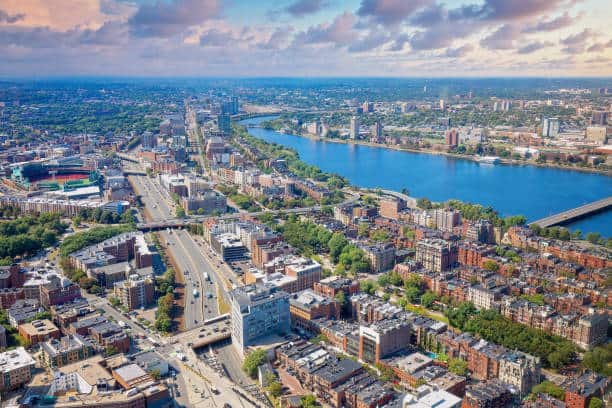
Every neighborhood has a center. Charlestown has its Monument Square; the North End has Hanover Street; the South End has its squares. Ask where the center of the Fenway is and you get an answer that exists in no other Boston neighborhood: a baseball stadium and a half-mile of hospitals.
The Fenway-Kenmore is the outlier of identity. It is a residential neighborhood with no residential downtown — no Main Street to anchor it — and its real estate behaves accordingly. If you try to read this market the way you'd read Beacon Hill or West Roxbury, you will misjudge it completely.
A center of gravity that isn't a downtown
Two institutions define the daily rhythm here, and neither is a neighborhood in the traditional sense.
The first is Fenway Park, opened in 1912 — the oldest ballpark in Major League Baseball. Eighty-one home games a year reorganize the streets around it: parking, foot traffic, restaurant volume, the whole tempo of life shifts on game day in a way no other Boston neighborhood experiences.
The second, and the one that actually drives the housing market, is the Longwood Medical Area — one of the largest concentrations of medical and research employment in the world, with 50,000-plus jobs anchored by Harvard Medical School, Brigham and Women's, Beth Israel Deaconess, Dana-Farber, and Boston Children's. Hospitals don't lay off the way tech companies do. That employment base is, in practical terms, recession-resistant — and it sits a walk away from the Fenway's front door.
Wrap a ring of universities around that — Northeastern, Boston University at Kenmore, Berklee, Emmanuel, Simmons, Wentworth, MassArt — and you've described the neighborhood's true engine: not homeowners, but a permanent, renewing population of students, residents (the medical kind), and researchers.
Culture where the houses should be
What the Fenway lacks in single-family streets it makes up for in institutions most cities would build an entire district around. The Museum of Fine Arts and the Isabella Stewart Gardner Museum are both here. Symphony Hall sits at the edge. The Back Bay Fens itself — the namesake of the neighborhood — is a Frederick Law Olmsted creation, a former tidal saltmarsh transformed into a link in the Emerald Necklace, complete with the Kelleher Rose Garden and the oldest continuously operating victory gardens in the country.
So the "what makes it special" answer is unusual: in most neighborhoods, the homes are the point and the amenities support them. In the Fenway, the institutions are the point and the housing exists to serve them.
A market of renters, not owners
Here's the structural fact that trips up out-of-town buyers: single-family homes in the Fenway are virtually nonexistent. The housing stock is condos and apartment buildings — much of it converted from the elegant late-1800s housing built for Boston's elite, the bones of a National Register historic district — and the population is overwhelmingly tenant, not owner.
Boston as a whole is about 64% renter-occupied. The Fenway runs dramatically higher. That single number changes how every transaction works:
- For investors, this is the thesis neighborhood. A perpetual, institutionally-anchored tenant base — 50,000 medical workers who don't leave plus tens of thousands of students who turn over every year — produces some of the most durable rental demand in the city. One-bedrooms commonly rent in the $2,900+ range, and condo gross yields here can run in the 5%+ zone, which is hard to find in Boston proper.
- For owner-occupants, read the price data carefully. Headline medians for the Fenway swing wildly depending on what's being counted — anywhere from the mid-$500,000s for a typical condo to $1M+ when new luxury product dominates the mix. A reported double-digit "decline" usually reflects a shift in what sold (more entry-level condos closing, fewer trophy units) rather than any individual home losing value. The institutional demand floor doesn't move.
The new Fenway, layered on the old
For most of the last century the Fenway was student housing and brownstone walk-ups. Over the past decade a wave of ground-up luxury development — the glassy mid-rises along Boylston and Van Ness — has layered a high-end condo market on top of the historic stock. The result is a neighborhood that now offers both a $550K starter condo and a $1.5M new-construction unit within the same few blocks, sharing the same ballpark and the same hospitals.
The takeaway
The Fenway is an outlier because it inverts the usual order of things: the institutions came first, the residents serve them, and the market is built on rent rather than ownership. That makes it the wrong neighborhood for a buyer who wants a quiet street and a single-family house — and arguably the right one for an investor who wants a tenant base that doesn't blink during a downturn.
Read it as a homeowner's market and the numbers look volatile. Read it as what it actually is — an institutional, renter-driven market with a recession-resistant demand floor — and the volatility turns into one of the more legible investment cases in the city.
If you're weighing the Fenway as a place to live or a place to own as an investment, those are two very different analyses — and we're happy to run whichever one fits your goal.
That closes our first three Outliers of Boston. Have a neighborhood you think breaks the rules? Tell us — it may be next.
— Remmes & Co. | Boston Real Estate