
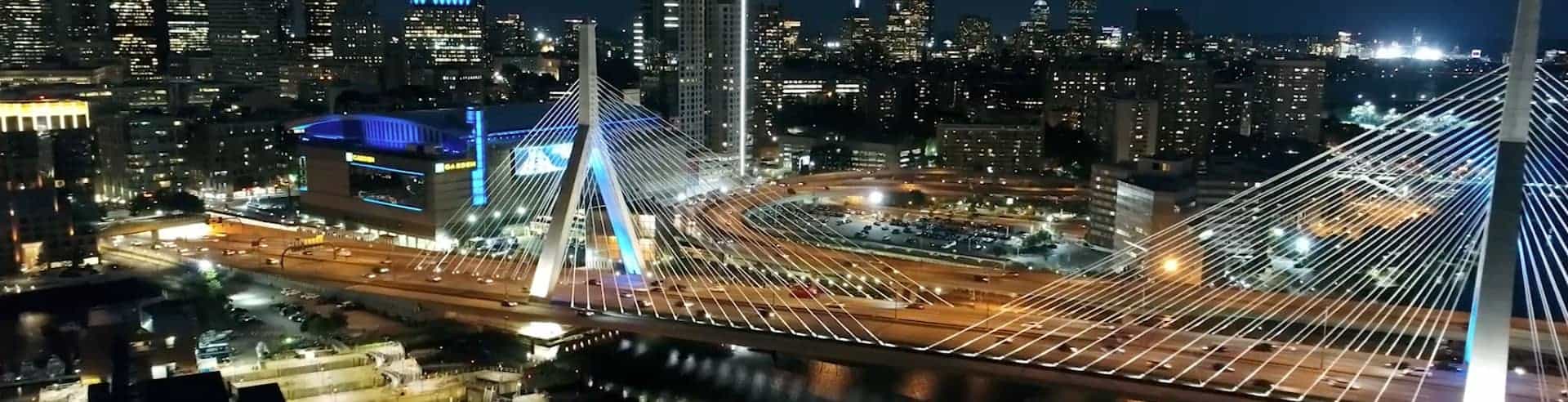
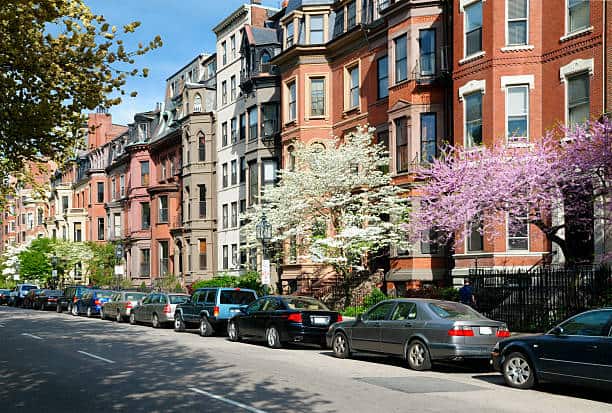
 Back Bay continues to anchor Boston's luxury multifamily market in 2026, holding its reputation as one of the most expensive, supply-constrained, and investor-favored rental neighborhoods in the Northeast. Bordered by the Charles River, the Public Garden, and the South End, this 1.5-square-mile neighborhood combines protected historic brownstone blocks along Commonwealth Avenue and Marlborough Street with high-rise towers along Boylston, Huntington, and the Prudential corridor — a mix that produces consistently tight fundamentals even as the broader Boston metro absorbs heavy new supply.
This Back Bay multifamily market report breaks down where rents, vacancy, cap rates, and investment activity stand in Q2 2026, and what owners, buyers, and renters should expect for the rest of the year.
Back Bay Rent Snapshot: Among Boston's Highest
Back Bay remains one of Boston's most expensive neighborhoods to rent an apartment. Rent aggregators place the average monthly rent for a Back Bay apartment between roughly $3,400 and $4,800 depending on property mix and data source, with the average apartment rent at approximately $4,787, up 1.09% year over year according to RentCafe's March 2026 update.
By unit type, Back Bay averages look like this:
-
Studios: roughly $2,500 to $3,440 per month, with smaller boutique units averaging around 514 square feet
-
One-bedrooms: typically $3,150 to $4,300 per month, with new-construction units at the top of the range
-
Two-bedrooms: $4,300 to $5,800 per month, driven by luxury inventory on Boylston Street and along the Prudential Center corridor
-
Three-bedrooms: $5,800 to $8,700+ per month, with full-floor brownstone units and penthouse rentals pushing the top end
Compared to the Boston citywide average of roughly $3,638 per month, Back Bay sits well above the citywide average at $4,787, placing it in the same rent tier as Downtown/Financial District and South Boston. For context on the premium, Back Bay rents run approximately 75% to 80% higher than the national average.
Year-Over-Year Rent Trend
Rent growth in Back Bay has moderated sharply from the post-pandemic peaks. Most data sources now show either flat or low single-digit year-over-year growth:
-
RentCafe: +1.09% YoY
-
RentHop: 1-bedroom rents flat, studios up ~7.7%, 3-bedrooms down ~13.7%
-
Zumper: unchanged over the trailing 12 months
This cooling mirrors the broader Boston metro, where deliveries outpaced absorption over the past year and asking rents were roughly flat year over year as the market absorbed recent supply additions.
Back Bay Vacancy and Leasing Velocity
Back Bay continues to run tighter than the Boston metro as a whole. Greater Boston multifamily vacancy reached 7.4% in early 2026 as deliveries outpaced absorption, though this remained 200 basis points below the national average. Back Bay, by contrast, typically runs below that metro figure because of its limited developable land, historic district protections, and consistent renter demand from Berklee College of Music, Boston Conservatory, Boston Architectural College, nearby hospitals, and Back Bay's large professional base.
The trade-off renters feel in 2026 is a slightly longer leasing timeline. The median days on market for a Boston apartment is now 24 days, compared to 19 days in January 2025 — apartments are leasing out roughly five days slower in 2026. In Back Bay specifically, BMN Boston data pegs average days on market at approximately 22 days — still fast by national standards, but a measurable loosening from the frenetic 2022-2023 cycle.
For owners, this means concessions (one month free, waived amenity fees, flexible start dates) are back as a leasing tool on newer Back Bay luxury product, particularly in Q1 and Q4 when leasing velocity traditionally slows.
Back Bay Multifamily Investment Outlook
Cap Rates and Pricing
Back Bay remains a core gateway submarket, and cap rates reflect that premium positioning. CBRE's 2026 Boston Real Estate Market Outlook places stabilized multifamily cap rates in the 4% to 5.5% range — compressed compared to secondary markets but reflecting lower perceived risk and stronger long-term appreciation potential.
For Back Bay specifically, investors should generally underwrite:
-
Class A stabilized: 4.0% to 4.75% cap rates — institutional trophy product like the Prudential-area high-rises and newer Boylston Street towers
-
Class B value-add brownstones: 4.5% to 5.25% cap rates — historic townhome conversions with below-market rents and deferred capex
-
Small 2-to-4 unit buildings: thinner cap rates, typically underwritten more on price per unit and appreciation than yield
On a price-per-unit basis, Boston multifamily pricing averages roughly $450,000 per unit — nearly double the national average — while cap rates have held near 5.1%. Back Bay consistently trades well above that metro average, often $600,000 to $900,000+ per unit for newer product, and higher still for trophy brownstones on Commonwealth Avenue and Marlborough Street.
Who's Buying in Back Bay
Private capital remains especially active in Boston multifamily, though institutional and public buyers continue to account for a significant share of large transactions. In Back Bay, the buyer pool is split between:
-
Private high-net-worth buyers acquiring single brownstones and small portfolios
-
Family offices and 1031 exchange capital from out-of-state sellers
-
Institutional funds targeting larger mixed-use and high-rise assets
Financing Conditions
Long-term mortgage rates have eased into the low-to-mid 6% range in early 2026, and the Federal Housing Finance Agency increased agency multifamily loan purchase caps for 2026 — a positive signal for financing availability in the multifamily segment. For Back Bay deals specifically, investors should expect:
-
65% to 75% LTV on commercial-sized deals (5+ units)
-
Minimum 1.25x DSCR stress-tested at higher rate scenarios
-
Tighter terms on historic district properties due to capex complexity
What's Driving Back Bay's 2026 Outlook
Supply Constraints
Back Bay's inventory is effectively capped. The Back Bay Architectural District, Commonwealth Avenue Mall landmark protections, and limited large-parcel opportunities mean almost no meaningful new supply enters the submarket in any given year. Most Back Bay "new construction" in 2026 is actually adaptive reuse or tower infill along Boylston, Huntington, and Dalton Street — high-rent, Class A product that does not directly compete with the brownstone rental stock.
Citywide, the picture is different. Boston currently has about 10,000 units under construction, representing roughly 3.4% of existing inventory, with a large share concentrated in Somerville/Charlestown and Everett/Malden/Medford/Melrose. Back Bay benefits from the fact that most of this supply is landing in submarkets well outside its competitive set.
Demand Drivers
Back Bay's renter demand rests on a diverse, durable base:
-
Professionals working in the Financial District, Seaport, and Longwood Medical Area (all reachable within 20 minutes via MBTA)
-
Students at Berklee, Boston Conservatory, BAC, and nearby BU and Northeastern
-
Medical residents and fellows at MGH, Brigham and Women's, and Beth Israel
-
Relocating executives drawn to walkability, Newbury Street retail, and access to the Esplanade
Policy Risk to Watch
The single biggest wild card for Back Bay multifamily owners in 2026 is rent control. A statewide ballot measure would cap annual rent increases at 5% or CPI, whichever is lower, with exceptions for owner-occupied 4-unit-or-smaller buildings and new construction less than 10 years old. Voters will only get to weigh in on the rent control proposal if the state Legislature doesn't pass related legislation by May 5.
For Back Bay specifically, where most buildings predate 1930 and would not qualify for the new-construction exemption, passage could materially change operating assumptions. Owners should stress-test underwriting at a 5% annual rent cap.
Back Bay vs. Other Boston Submarkets: 2026 Snapshot
| Submarket | Avg. Rent (All Units) | Typical Cap Rate | Market Tone |
| Back Bay | $4,787 | 4.0%–5.25% | Tight, high-rent, low-supply |
| South Boston | $4,197 | 4.5%–5.5% | Strong waterfront demand |
| Downtown/Financial | $4,539 | 4.5%–5.5% | Office-adjacent, stable |
| Fenway–Kenmore | ~$3,400 | 4.75%–5.75% | Student-driven, steady |
| South End | ~$3,800 | 4.75%–5.75% | Appreciation play |
| Dorchester | ~$2,800 | 5.5%–6.5%+ | Value-add, triple-decker market |
2026 Outlook: What to Expect for the Rest of the Year
Three scenarios look most likely for Back Bay multifamily through year-end 2026:
-
Rents stay roughly flat as the metro absorbs the 2025 supply wave. Expect year-end growth of 0% to 2%.
-
Vacancy holds under the metro average, in the 4% to 5.5% range for stabilized Back Bay product, as the neighborhood's structural supply constraints continue to work in owners' favor.
-
Investment volume picks up modestly as rate stability returns and bid-ask spreads narrow. Private capital and 1031 buyers will remain the most active pool.
The one disruption scenario worth planning for: a yes vote on the November 2026 rent control ballot question. Back Bay owners would see operating assumptions change overnight, and cap rates could expand 25 to 75 basis points as buyers reprice the policy risk.
Frequently Asked Questions
What is the average rent in Back Bay Boston in 2026?
The average Back Bay apartment rents for approximately $4,787 per month as of March 2026, up about 1% year over year. One-bedrooms average roughly $4,083, and two-bedrooms average roughly $5,832.
Is Back Bay a good multifamily investment in 2026?
Back Bay is a classic gateway-market investment: low cap rates (4%-5.25%), strong appreciation history, and deep renter demand. It is not a cash-flow play — it is a long-term appreciation and wealth-preservation play. Investors should underwrite conservative rent growth and stress-test for potential rent control.
How does Back Bay compare to the Boston metro multifamily market?
Back Bay rents run roughly 30% above the Boston citywide average and vacancy runs below the 7.4% metro figure. Supply is structurally constrained, which supports pricing even when the broader metro softens.
What risks should Back Bay multifamily investors watch in 2026?
The top three are (1) the November 2026 statewide rent control ballot question, (2) softer rent growth if Boston metro supply keeps outpacing absorption, and (3) insurance and capex inflation on older brownstone properties.
Looking for a property-specific valuation or custom Back Bay multifamily underwriting? Contact us for a confidential consultation.