

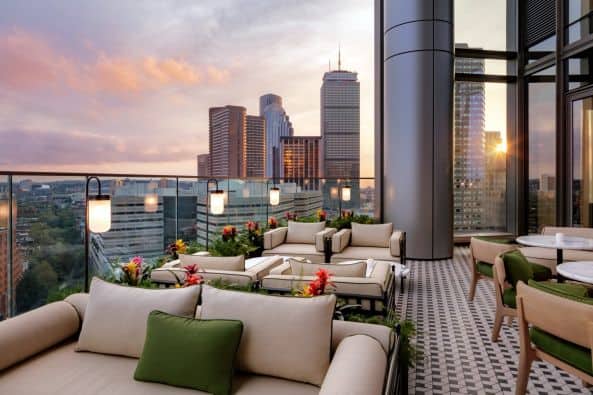
 Introduction: The Most Undervalued Square Footage in Boston Luxury Real Estate
Here’s a scenario that plays out constantly in the Boston luxury condo market. A buyer is deciding between two properties. Unit A is a 2,400-square-foot three-bedroom with a beautifully finished interior and no outdoor space. Unit B is a 2,100-square-foot two-bedroom — 300 square feet smaller, one fewer bedroom — but it has a private, fully built-out roof deck with skyline views.
Five years ago, most buyers picked Unit A without hesitation. More bedrooms, more square footage, straightforward math. Today, in Charlestown, the Seaport, South End, and Back Bay, the market is telling a very different story. Unit B is selling faster, closing at a higher price per square foot, and generating stronger buyer interest from the moment it hits the MLS.
Private outdoor space — particularly a well-designed, fully appointed roof deck — has become one of the most powerful differentiators in Boston’s luxury condo market. And if you’re a serious buyer weighing this exact trade-off, this article is going to give you the data and the framework to make the right decision.
Why Private Outdoor Space Commands a Premium in Boston
Boston is not Miami. It’s not Los Angeles. You’re not going to use your roof deck twelve months a year. And yet, private outdoor space in this market commands a premium that consistently surprises buyers who are thinking about it purely in terms of calendar days.
Here’s why.
Scarcity Drives Value
In a city defined by density — historic building codes, narrow lots, aggressive zoning — private outdoor space is genuinely rare. Most Boston condos offer nothing more than a window. Even in newer luxury developments, private outdoor space is typically reserved for penthouse units or offered as an upgrade that adds six figures to the price. When a property in Charlestown has a deeded, private roof deck, it immediately separates itself from 90% of the comparable inventory.
That scarcity isn’t going away. Boston’s development landscape is constrained by historic preservation requirements, height restrictions, and a permitting process that makes new outdoor space difficult and expensive to create. Every roof deck that exists today is, in many cases, the only one that will ever exist on that building. That’s a fundamentally different value proposition than an extra bedroom, which can be found in countless comparable units.
The Post-2020 Premium Is Real and Permanent
It’s tempting to dismiss the outdoor-space boom as a pandemic hangover that’s fading. The data suggests otherwise. In the years following 2020, luxury buyers in Boston permanently recalibrated how they think about living space. Private outdoor access moved from a “nice to have” to a core requirement for a substantial percentage of buyers in the $1.5M+ range.
The behavior change isn’t about working from home. It’s about how people experience their homes. A roof deck isn’t just a place to sit outside. It’s a second living room from May through October. It’s where you host friends. It’s where you take your morning coffee and your evening drink. It’s the space that makes a 2,100-square-foot condo feel like a 3,000-square-foot home.
Emotional Value Closes Deals
Here’s something that doesn’t show up in appraisals but absolutely shows up in offers: a roof deck creates an emotional response that an extra bedroom simply cannot match. I’ve watched buyers walk through perfectly appointed interiors with neutral expressions, then step onto a roof deck with a view of the Zakim Bridge and the Boston skyline and immediately say, “This is it.”
That emotional connection drives urgency. It reduces negotiation. It creates multiple-offer situations. In a market where luxury buyers have options, the property that creates an emotional reaction is the one that sells — and a well-designed roof deck does that more consistently than any other single feature.
How Roof Decks Affect Days-on-Market and Final Sale Price in Charlestown
Let’s look at the numbers specific to Charlestown, because this is where the roof deck premium is most pronounced in Boston.
Charlestown’s housing stock is a mix of historic conversions (19th-century row houses and former industrial buildings turned into condos) and newer construction. The neighborhood’s topography — built on a hill, bordered by water on three sides — means that roof deck views here are exceptional. You’re looking at the Bunker Hill Monument, the Boston Harbor, the Zakim Bridge, and the downtown skyline.
That combination of historic character and dramatic views makes Charlestown roof decks some of the most desirable private outdoor spaces in the city. And the market reflects it.
Days on market: Luxury condos in Charlestown with private roof decks consistently spend 15–25% fewer days on market than comparable units without outdoor space. In a market where the average luxury listing might sit for 45–60 days, that difference can mean selling in under 40 days versus lingering past 60.
Price per square foot: Properties with well-appointed private roof decks in Charlestown typically trade at a 10–18% premium on a per-square-foot basis compared to similar units without outdoor space. On a $2M property, that premium translates to $200K–$360K in additional value attributable directly to the outdoor space.
Multiple offers: Listings with private roof decks in the $1.5M–$3M range generate multiple offers at a significantly higher rate than those without. The outdoor space creates a sense of uniqueness and scarcity that drives competitive bidding.
These aren’t abstract market trends. They’re patterns I see in every comp analysis I run for clients looking at Charlestown properties. The roof deck premium is real, measurable, and consistent.
What Separates a High-Value Roof Deck from a Basic One
Not all roof decks are created equal. A bare, unfinished rooftop with a couple of plastic chairs and no infrastructure is not the same as a professionally designed outdoor living space. Here’s what separates a roof deck that adds significant value from one that’s essentially a flat roof you’re allowed to stand on.
Built-In Grill Station
A permanent, plumbed-in gas grill (ideally a built-in unit from a brand like Lynx, DCS, or Weber Summit) transforms the deck from a sitting area to an outdoor kitchen. This is the single most impactful feature for both daily use and resale value. If the grill has a dedicated gas line rather than relying on propane tanks, even better — it signals permanent infrastructure, not a temporary setup.
Beyond the grill itself, look for counter space on either side, storage underneath, and ideally a small outdoor sink. These elements create a functional cooking station that makes the roof deck a genuine entertainment venue, not just a place to stand outside.
Irrigation System for Planters
This is one of the details that separates a thoughtfully designed roof deck from one that was built to check a box. A built-in drip irrigation system connected to dedicated planters means you can maintain greenery without daily manual watering. In Boston’s hot summers, roof deck planters dry out fast. Without irrigation, most buyers abandon the plants by August.
When a roof deck has a genuine irrigation system with a timer, it tells me the original designer thought about how the space would actually be used over time — not just how it would look on listing day.
Wind Screens and Privacy Elements
Boston is windy. Charlestown, sitting on the harbor, is windier than most. A roof deck without wind mitigation is uncomfortable for much of the season. Glass wind screens, strategically placed planters with tall grasses, or architectural privacy walls serve a dual purpose: they block wind and create a sense of enclosure that makes the space feel like a room, not just a platform.
Look for wind screens that are tempered glass (not plexiglass, which yellows and scratches), securely anchored, and positioned to block the prevailing northwest wind without completely enclosing the space. The best designs maintain 180+ degrees of open views while protecting the seating and dining areas.
Wired for Audio, Lighting, and Power
A high-value roof deck has been wired with outdoor-rated electrical outlets (GFCI protected), dedicated lighting circuits, and pre-wired speaker connections. This infrastructure is expensive and disruptive to install after the fact — it often requires running conduit through the building’s interior — so its presence in a new listing is a significant value add.
For lighting, look for a layered approach: overhead string lights or pendant fixtures for ambient lighting, step lights for safety, and accent lights that highlight architectural features or plantings. A single floodlight is functional but uninviting. A thoughtfully lit roof deck is usable — and beautiful — well after sunset.
For audio, pre-wired speaker mounts with weather-resistant speakers (Sonance, Coastal Source, or Bose Professional outdoor series) that connect to the home’s sound system make the deck a seamless extension of the interior living space.
Premium Decking Material
The decking surface matters more than most buyers realize. Composite decking (Trex, TimberTech, Azek) or Ipe hardwood are the standards in luxury applications. Pressure-treated pine — while technically functional — requires annual maintenance, splinters, and grays unevenly. If a $2M+ property has pressure-treated pine on the roof deck, the developer cut corners.
Porcelain pavers on pedestal systems are another premium option that’s gaining popularity in Charlestown’s newer builds. They’re virtually maintenance-free, allow for drainage beneath the surface, and create a sleek, modern aesthetic. Look for a minimum of 2cm thickness for structural integrity.
Permitting and HOA Considerations Buyers Should Ask About Before Closing
This is the section that could save you from a very expensive mistake. Roof decks in Boston — and Charlestown in particular — come with a regulatory and HOA landscape that every serious buyer needs to understand before making an offer.
Permitting
In the City of Boston, any significant roof deck construction or modification requires permits from the Inspectional Services Department (ISD). If the roof deck was built as part of the original development, permits should be on file. If it was added later by a previous owner, verify that permits were pulled and closed. An unpermitted roof deck is a liability — it can affect your insurance, your ability to sell, and potentially require removal.
Key questions to ask the listing agent or seller: Was the roof deck part of the original building permit? If it was added later, are there closed permits on file with ISD? Has the structural load been certified by a licensed engineer? Are the railings and safety features up to current code?
In Charlestown’s historic district, there are additional considerations. The Charlestown Neighborhood Council and the Boston Landmarks Commission may have reviewed the roof deck design for compatibility with the neighborhood’s historic character. If the deck is visible from the street, there may be restrictions on railings, materials, and height that could limit future modifications.
HOA Rules and Restrictions
If you’re buying a condo with a roof deck, the HOA documents deserve careful review — more careful than most buyers give them. Key things to look for:
Exclusive use vs. common area: Is the roof deck deeded to your unit as exclusive-use space, or is it common area that you have access to by agreement? Exclusive-use is significantly more valuable because it’s legally yours to control and enjoy. Common-area access can be revoked or modified by HOA vote.
Maintenance responsibility: Who pays for roof deck maintenance, waterproofing, and structural repairs? In many Boston condo associations, the roof membrane beneath the deck is a common-area expense, but the deck surface, railings, and furnishings are the unit owner’s responsibility. Understand exactly where the line is drawn.
Usage restrictions: Some HOAs limit grill use (fire codes), noise levels, hours of use, and even the type of furniture allowed on the deck. These restrictions aren’t necessarily deal-breakers, but you need to know about them before you close, not after your first dinner party gets shut down by a neighbor’s complaint.
Insurance implications: A private roof deck may affect your condo insurance premiums or require an additional rider. Some insurance carriers want to know about the deck’s construction, safety features, and whether it’s been professionally inspected. Ask your insurance broker to review the specifics before closing.
Insurance and Maintenance Realities
I want to give you the complete picture — including the costs that come with owning a roof deck — because making a fully informed decision is the only way to buy well.
Insurance
A private roof deck typically adds $500–$1,500 per year to your condo insurance premium, depending on the size of the deck, the presence of a built-in grill or kitchen, and the carrier. If the deck has a gas grill line, some carriers require a specific rider for that. It’s a real cost, but relative to the premium the deck adds to your property value, it’s marginal.
Make sure your policy covers the deck structure, furnishings, and any built-in features (grill, speakers, lighting). Standard condo policies often exclude outdoor structures unless explicitly added. Your insurance broker should be reviewing this as part of your purchase process.
Maintenance
A well-built roof deck in Boston requires consistent seasonal maintenance. Here’s what to budget for:
Spring opening and fall closing: $500–$1,500 per season for a professional to clean the deck surface, inspect railings and structural connections, service the grill, test irrigation, and manage planters. Most luxury owners hire a service for this.
Annual waterproofing inspection: $300–$800 for a roofing professional to inspect the membrane beneath the deck and verify that drainage is functioning properly. This protects both your investment and the units below you.
Furniture maintenance: High-quality outdoor furniture (Restoration Hardware, Gloster, Dedon) lasts for years but needs annual cleaning, cover replacement, and occasional refinishing. Budget $500–$1,000 per year depending on the scope of your furnishings.
Long-term replacement: Composite decking typically lasts 25–30 years. Ipe hardwood lasts 40+ years with proper maintenance. Porcelain pavers are essentially permanent. Plan for eventual resurfacing, but it’s a decade-plus timeline for quality installations.
Total annual maintenance cost for a well-appointed roof deck runs roughly $2,000–$4,000. On a property worth $2M+, that’s a rounding error relative to the value the space provides.
The Math: Roof Deck vs. Extra Bedroom
Let’s put it all together with a practical comparison that reflects what I see in the Charlestown market.
Scenario: You’re choosing between two condos listed at similar price points.
Unit A: 2,400 sq ft, 3 bedrooms, no outdoor space. Listed at $2.1M.
Unit B: 2,100 sq ft, 2 bedrooms, private roof deck with built-in grill, irrigation, lighting, and harbor views. Listed at $2.15M.
On paper, Unit A offers more interior space and an extra bedroom. Unit B costs slightly more for less interior square footage. But here’s what the market data tells us:
Unit B will likely sell faster — 15–25% fewer days on market. Unit B will likely close at or above asking, while Unit A is more likely to see price negotiation. At resale in 5–7 years, Unit B’s roof deck will have appreciated at a higher rate than Unit A’s extra bedroom, because scarcity drives outdoor-space values upward while bedroom counts are easily matched by competing inventory.
The third bedroom in Unit A adds utility if you have a growing family. But if your primary use case is a guest room or home office, that bedroom is fungible — it’s a feature that can be found in dozens of comparable listings. A private roof deck with harbor views in Charlestown cannot.
The Bottom Line for Serious Boston Luxury Buyers
If you’re actively comparing properties in Charlestown or greater Boston and one of them has a private roof deck, don’t dismiss it because the interior is 200 square feet smaller or it’s missing a bedroom. Run the numbers. Consider how you’ll actually use the space. Think about the resale story you’re building.
In a market defined by scarcity, density, and intense buyer competition at the luxury level, a private roof deck is one of the very few features that genuinely cannot be replicated. You can renovate a kitchen. You can knock down a wall to create an open floor plan. You cannot create a private roof deck where one doesn’t exist.
That’s the kind of advantage that compounds over time. And it’s the kind of detail that separates a smart purchase from a merely adequate one.
Looking for a Charlestown property with private outdoor space? I keep a running list of off-market and upcoming listings with roof decks and private outdoor areas in Charlestown, the Seaport, and Back Bay. If you want early access before they hit the MLS, let’s connect.