

 The technologies and policies driving profitability and climate resilience across Greater Boston's most ambitious managed buildings.
Boston has always been a city that reinvents itself. From the landfill that created Back Bay in the nineteenth century to the Big Dig that reclaimed its waterfront at the turn of the twenty-first, the city has a long history of rethinking the built environment. Now, facing an existential threat from rising seas, extreme heat, and a mandate to reach carbon neutrality by 2050, Boston is in the midst of its most consequential building transformation yet — and this time, it's paying for itself.
Buildings account for roughly 70 percent of Boston's greenhouse gas emissions. That statistic is the engine behind the city's Building Emissions Reduction and Disclosure Ordinance (BERDO 2.0), which requires all large commercial and residential buildings to progressively cut emissions to net zero by 2050. Compliance deadlines began in 2025 for the largest buildings, with all covered properties on the clock by 2030. For building owners, the regulation isn't just an environmental requirement — it's a financial signal. Properties that invest in green technology now are commanding higher rents, attracting premium tenants, and insulating themselves from the steep fines and operational costs that will only grow over the next two decades.
What follows is a look at the specific green building technologies that are being adopted across Boston, the managed buildings that exemplify them, and the financial and resilience returns that are making these investments irresistible.
Passive House Design: Cutting Energy Demand at the Source
Of all the green building strategies gaining traction in Boston, none has attracted more attention than Passive House design. Originating in Germany in the 1980s, the Passive House standard requires buildings to meet strict performance criteria for heating and cooling demand, airtightness, and ventilation. The result is structures that use dramatically less energy than conventional buildings — not through expensive mechanical systems, but through better envelopes, insulation, and airflow management.
Winthrop Center — The World's Benchmark
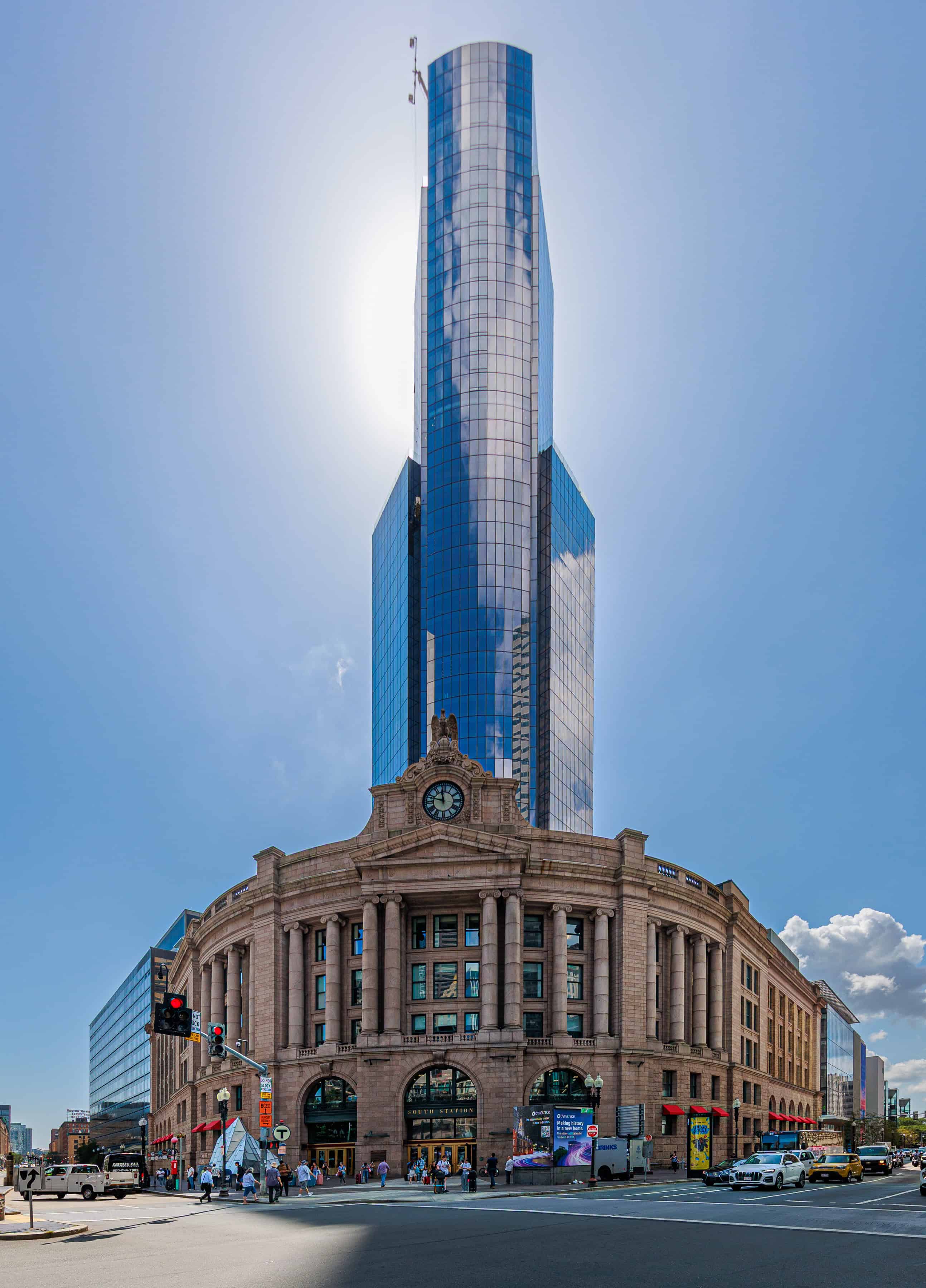
The most celebrated example is Winthrop Center, the 53-story, $1.4 billion mixed-use tower in Boston's Financial District developed by Millennium Partners and designed by Handel Architects. Certified by the Passive House Institute in 2023, its approximately 812,000 square feet of Class A office space make it the largest Passive House commercial building in the world. The 691-foot tower also holds LEED Platinum certification and is targeting WELL Gold.
Winthrop Center achieves its performance through a combination of triple-pane windows that minimize air leakage, mineral wool insulation between exterior and interior walls, specially sealed ventilation ducts, and high-efficiency energy recovery ventilation (ERV) systems. The building's pleated curtainwall, designed by Handel Architects, isn't just aesthetic — the bay-window geometry orients glazing to the northwest, passively reducing solar heat gain while maximizing natural light. Exterior fins supplement this passive shading strategy.
The results speak for themselves. The building uses roughly 65 percent less energy than a typical Class A office building in Boston. According to the Passive House Network, existing LEED Platinum buildings in Boston use about 60 percent more energy than Winthrop Center's office space. Developer Millennium Partners reports that the Passive House features added approximately 3 percent to construction costs — about $15 million — but this is being more than recouped through a 25 percent rental premium that tenants are willing to pay. Over a 100,000-square-foot lease spanning ten years, tenants can expect to save up to $2 million in utility costs compared to a conventional building.
"This building is important because it paves a path for new development," said Brad Mahoney, Millennium Partners' director of sustainable development. In 2024, Boston adopted the Massachusetts opt-in building code, requiring new large multifamily buildings to meet Passive House requirements — a policy shift that Winthrop Center helped catalyze.
Geothermal Energy: Tapping the Earth Beneath the City
While Passive House design reduces demand, geothermal systems tackle the supply side by eliminating fossil fuel combustion entirely. Ground-source heat pumps circulate fluid through deep underground boreholes, exploiting the earth's stable subterranean temperature to provide both heating and cooling without burning gas or oil.
Boston University Center for Computing & Data Sciences
Boston University's Center for Computing & Data Sciences — nicknamed "the Jenga building" for its cantilevered, stacked-block form designed by KPMB Architects — is Boston's largest fossil-fuel-free building and a showcase for geothermal technology at scale. The 19-story, 350,000-square-foot structure was designed to achieve LEED Platinum and is targeting net zero carbon emissions. Suffolk Construction drilled and installed 31 geothermal bores, each plunging 1,500 feet beneath Commonwealth Avenue to harness the thermal mass of the earth. These bores supply the building's heating and cooling needs without any connection to gas infrastructure.
The building's sustainability profile goes beyond its mechanical systems. Its stepped massing creates balconies and green roofs at multiple levels, providing occupants with fresh air access and views while reducing the heat island effect. Interior "irresistible staircases" with sweeping terraces are designed to encourage occupants to walk rather than ride elevators, reducing both energy use and sedentary behavior. The project aligns with BU's Climate Action Plan goal of net zero emissions by 2040 — a decade ahead of Boston's own 2050 target.
Geothermal is increasingly viable in urban settings thanks to advances in drilling technology and declining installation costs. For large institutional and commercial buildings, the technology offers a hedge against volatile fossil fuel prices and positions properties for long-term BERDO compliance without the need for ongoing renewable energy purchases or carbon offsets.
Chilled Beam HVAC and Rainwater Harvesting: The Seaport's Efficiency Leaders
Boston's Seaport District, built largely on filled land and acutely vulnerable to sea-level rise, has become a proving ground for integrated green building systems that combine energy efficiency with water resilience.
121 Seaport
121 Seaport, a 17-story elliptical office tower designed by CBT Architects, earned LEED Platinum certification through a holistic design approach that starts with the building's very shape. Its elliptical form is oriented to passively minimize solar heat gain, delivering approximately 15 percent in energy savings. The aerodynamic design also reduces lateral wind force by about 30 percent, decreasing the structural reinforcement required and lowering overall construction costs.
Inside, 121 Seaport uses a chilled beam mechanical system — circulating chilled water rather than forced air to regulate temperatures. This approach consumes significantly less energy than conventional HVAC while providing quieter, more uniform comfort. A rooftop rainwater harvesting system collects precipitation and recycles it as graywater for the building's restrooms, reducing total water consumption by 30 percent. Construction incorporated 20 percent recycled materials, and the project pioneered "up-down construction," which simultaneously built the superstructure upward while excavating the underground garage, condensing the timeline by roughly six months and reducing construction-phase emissions.
101 Seaport Boulevard
Nearby, 101 Seaport Boulevard — a 440,000-square-foot Class A office tower managed by CBRE and owned by Union Investment Real Estate — also achieved LEED Platinum. The building features a cutting-edge mechanical cooling system that, in addition to energy efficiency, contributes to superior indoor air quality. Stormwater management systems, heat island reduction strategies, water-efficient landscaping, and a comprehensive green cleaning policy round out its sustainability profile — a testament to the market premium that green-certified office space commands in Boston.
Smart Building Platforms and AI-Driven Operations
The most transformative technology trend in Boston's managed buildings may be invisible to occupants: the rise of AI-powered building management systems (BMS) that continuously optimize energy use, predict maintenance needs, and adapt to real-time occupancy patterns.
One Congress
One Congress, a one-million-square-foot, 43-story trophy office tower at Bulfinch Crossing in downtown Boston, exemplifies the integration of smart building technology into luxury commercial space. Developed by The HYM Investment Group and owned through a joint venture between National Real Estate Advisors and Carr Properties, the tower — designed by Pelli Clarke Pelli Architects and CBT — was built with wellness, sustainability, and advanced technology as core design pillars. One Congress deploys IoT sensors throughout its systems to monitor HVAC, lighting, and air quality in real time. Occupancy-based automation adjusts climate and lighting dynamically, reducing waste during off-peak hours while maintaining comfort during full occupancy. The building opened 100 percent pre-leased, with State Street Corporation relocating its global headquarters there in 2023, underscoring the premium that top-tier tenants place on technologically advanced, sustainable office environments.
Across Boston's commercial portfolio, REITs and institutional owners are scaling these technologies. BXP (formerly Boston Properties), one of the nation's largest publicly traded developers and a major Boston presence, has invested heavily in boiler retrofits, heat exchangers, and improved filtration on cooling towers across its portfolio, and has set science-based emissions targets aligned with a 1.5°C warming trajectory. BXP requires all new developments to achieve LEED Silver or higher, and the company has committed to carbon-neutral operations for its occupied and actively managed buildings. The financial payoff is clear: BXP collected 99 percent of its rents throughout the pandemic, with tenants increasingly drawn to buildings that prioritize air quality, energy performance, and health.
Modern smart building platforms in Boston are leveraging digital twin technology — virtual replicas of physical buildings updated with real-time sensor data — to simulate operational changes before deploying them. These systems identify inefficiencies, predict equipment failures, and model the impact of weather events on building performance. For managed buildings, this translates directly into lower operating costs, longer equipment lifespans, and a competitive edge in tenant attraction.
 Building-Integrated Stormwater and Flood Resilience
Boston's geography demands that green building technology address not only emissions but also physical climate risk. One-sixth of the city sits on landfill, and neighborhoods including the Seaport, Back Bay, East Boston, and parts of downtown face increasing coastal flooding from sea-level rise and intensifying storms. The city's 2021 Coastal Flood Resilience Zoning Overlay District (Article 25A) now requires new construction and major retrofits in flood-prone areas to meet elevated design standards.
Atlantic Wharf
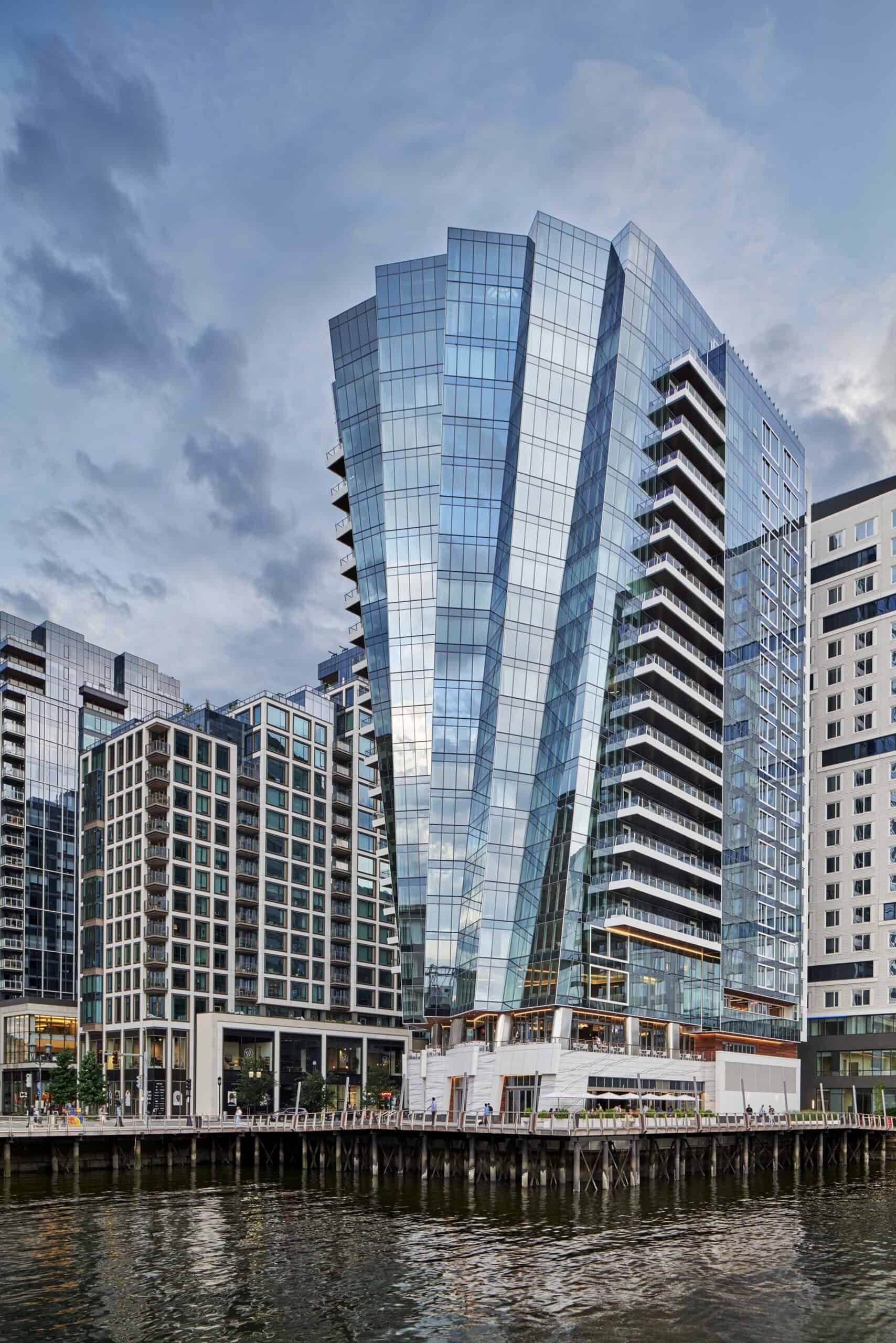
Atlantic Wharf, developed by BXP and often described as Boston's first green skyscraper, set an early standard for integrating stormwater resilience into commercial design. The 1.2-million-square-foot mixed-use development along the historic Fort Point Channel features an innovative water management system that reduced potable water use for irrigation by more than 60 percent and cut process water in cooling systems by 15 percent. Its public plazas function as stormwater biofilters, managing runoff while activating the streetscape. The project preserved and integrated approximately 42 percent of the existing historic structures on the site, including 19th-century facades, while achieving energy savings equivalent to the annual energy consumption of more than 260 average American households. Over 85 percent of construction waste was diverted from landfills.
Clippership Wharf — East Boston's Living Shoreline
Clippership Wharf in East Boston, developed by Lendlease, earned LEED Platinum certification in 2021 for its 284-unit waterfront community. What distinguishes Clippership Wharf is its first-of-its-kind "living shoreline" restoration — a naturalized buffer of salt marshes, rocky beaches, and wildlife habitats that functions as both ecosystem restoration and flood defense. The living shoreline absorbs wave energy, reduces erosion, and filters stormwater, while providing residents with direct kayak access to the harbor. This nature-based approach to resilience aligns with Boston's broader Resilient Boston Harbor vision, which prioritizes green infrastructure — floodable parks, rain gardens, living shorelines, and constructed wetlands — over traditional hardened seawalls.
Deep Energy Retrofits and Electrification: The Next Frontier
Boston's 2030 Climate Action Plan identifies deep energy retrofits of existing buildings as one of the highest-impact strategies for emissions reduction. Massachusetts' Climate Ready Housing program is channeling significant funding into this effort, with seven Boston projects receiving grants in 2025 alone.
Forbes Building — Jamaica Plain
The Forbes Building in Jamaica Plain, operated by the Jamaica Plain Company, is being revitalized to meet rigorous Passive House standards while preserving 147 income-restricted senior housing units. The deep retrofit includes advanced exterior cladding for superior insulation and integration of an all-electric heating and cooling system. A food forest and community gardens enhance resilience by supporting on-site food production and activating resident gathering spaces. The project demonstrates that green building technology is not limited to trophy office towers — it is equally transformative for affordable housing.
Brian J. Honan Apartments — Allston-Brighton
The Brian J. Honan Apartments, a 50-unit affordable housing complex managed by the Allston-Brighton CDC, is undergoing a deep energy retrofit anticipated to reduce energy consumption by 62 percent and carbon emissions by 51 percent. The project includes full electrification and on-site solar power generation. For affordable housing residents, these upgrades translate directly into lower utility costs, improved indoor air quality, and protection against energy price volatility.
The Southline Boston Model: Real-Time Air Quality Monitoring
Southline Boston, a mixed-use innovation campus on the former Boston Globe headquarters site in Dorchester developed by Beacon Capital Partners, earned LEED Core and Shell Silver certification by diverting more than 90 percent of its structural mass from waste streams during construction. But the building's most notable innovation may be its commitment to real-time indoor air quality (IAQ) monitoring. Data from 2023 and 2024 showed that Southline's air pollutant levels were 17 percent and 45 percent lower, respectively, than those of typical commercial office buildings. The building is also pursuing Fitwel certification and supports tenants with healthy food and social-justice-focused fitness programming through operators like Craft Food Hall and Inner City Weightlifting.
Real-time IAQ monitoring is increasingly seen as a competitive differentiator in Boston's office market. Post-pandemic tenants scrutinize ventilation and air quality data before signing leases, and buildings that can demonstrate measurably healthier environments are commanding occupancy and rental premiums.
Mass Timber: Slashing Embodied Carbon
While operational emissions from heating, cooling, and lighting have dominated the green building conversation, attention is shifting to embodied carbon — the greenhouse gases produced during the manufacture of building materials, especially steel and concrete. Cross-laminated timber (CLT) and other mass timber products are emerging as a powerful alternative.
MIT researchers modeled nine versions of an eight-story mass timber building alongside steel and concrete equivalents and found that the mass timber version produced up to 53 percent fewer greenhouse emissions from materials than the steel version. Contrary to intuition, large mass timber members retain structural strength longer than steel framing during a fire, as the thick, layered wood chars on the outside while maintaining integrity within.
Several mass timber projects are now in development across the Boston area, supported by the city's E+ Green Building Program and the Massachusetts opt-in specialized stretch energy code. As the construction industry faces mounting pressure to account for full lifecycle emissions, mass timber offers a viable path to reducing buildings' total carbon footprint while creating warm, biophilic interiors that attract premium tenants.
The Financial Case: Why Green Pays in Boston
The convergence of policy pressure, tenant demand, and technological maturity is making green building investment not just responsible but profitable.
BERDO 2.0 imposes escalating fines on buildings that fail to meet emissions standards, with non-compliant owners facing penalties that scale over time. But the incentives are equally compelling. The Inflation Reduction Act provides tax credits, bonus deductions, and grants for energy-efficient construction and retrofits. Massachusetts' MassCEC grant programs, PACE financing, and the Mass Save energy efficiency incentive program further reduce the capital burden. Boston's Community Choice Electricity program allows building owners to "opt up" to 100 percent local renewable energy as a direct BERDO compliance pathway.
The market signals are unmistakable. LEED-certified buildings in Boston consistently achieve higher occupancy rates, faster lease-up, and rental premiums compared to conventional stock. Winthrop Center charges 25 percent more than comparable conventional buildings — and tenants are paying willingly because their operating costs drop. Atlantic Wharf was 100 percent leased within its first year of opening. One Congress opened fully pre-leased. Major REITs like BXP are channeling capital toward sustainable development and green bond issuances to attract ESG-focused institutional capital.
For the city as a whole, Boston's position as the second-largest climatetech ecosystem by investment in the country is fueling a virtuous cycle: innovation lowers costs, lower costs accelerate adoption, and adoption creates the density of expertise and infrastructure that attracts still more investment.
Looking Ahead: Boston's Green Building Trajectory
Boston's 2030 Climate Action Plan — the first to fully integrate mitigation, resilience, and climate justice into a single framework — makes clear that the next five years will be the decisive window. Several trends will define this period:
Full electrification of new construction is rapidly becoming the default. Newer buildings like WS Development's 17-story Amazon tower in the Seaport rely entirely on electricity for heating and hot water, leapfrogging even Winthrop Center's still-gas-connected systems. As one city planning official noted, "Best practice five years ago is not best practice today."
District-scale geothermal networks and microgrids are moving from pilot projects to infrastructure planning, offering neighborhood-scale resilience against grid disruptions and reducing the need for individual building investments in backup power.
AI-driven building analytics will continue to evolve, with digital twins, predictive maintenance, and real-time energy optimization becoming standard in managed portfolios. Buildings that generate and share performance data will have a competitive advantage not only in tenant attraction but also in BERDO compliance verification.
Nature-based resilience — living shorelines, constructed wetlands, bioswales, and elevated landscapes — will increasingly be integrated into building-scale design, not just city infrastructure planning. Developments like Clippership Wharf's living shoreline point toward a future where buildings are expected to contribute to their neighborhoods' flood defense.
And embodied carbon accounting will shift from a niche concern to a regulatory requirement, accelerating the adoption of mass timber, recycled materials, and low-carbon concrete across the city's development pipeline.
Conclusion
Boston's green building transformation is not an abstract aspiration — it is happening now, in specific buildings, with specific technologies, and with measurable financial returns. From the Passive House engineering of Winthrop Center to the geothermal bores beneath BU's Jenga building, from the chilled beams of 121 Seaport to the living shoreline of Clippership Wharf, the city's most ambitious managed properties are demonstrating that profitability and climate resilience are not competing goals. They are the same goal.
For building owners, developers, and investors, the message is clear: the green building technologies of today are not premiums to be tolerated but investments that pay for themselves — in lower operating costs, higher rents, stronger occupancy, regulatory compliance, and protection against a climate future that is no longer theoretical. In Boston, the buildings that will thrive in the decades ahead are the ones being built and retrofitted right now.
Published April 2026. Sources include the City of Boston Environment Department, the Passive House Institute, the U.S. Green Building Council, Built Environment Plus, A Better City, ClimaTech Boston, BXP, Millennium Partners, Carr Properties, The HYM Investment Group, Beacon Capital Partners, and the Massachusetts Clean Energy Center.