
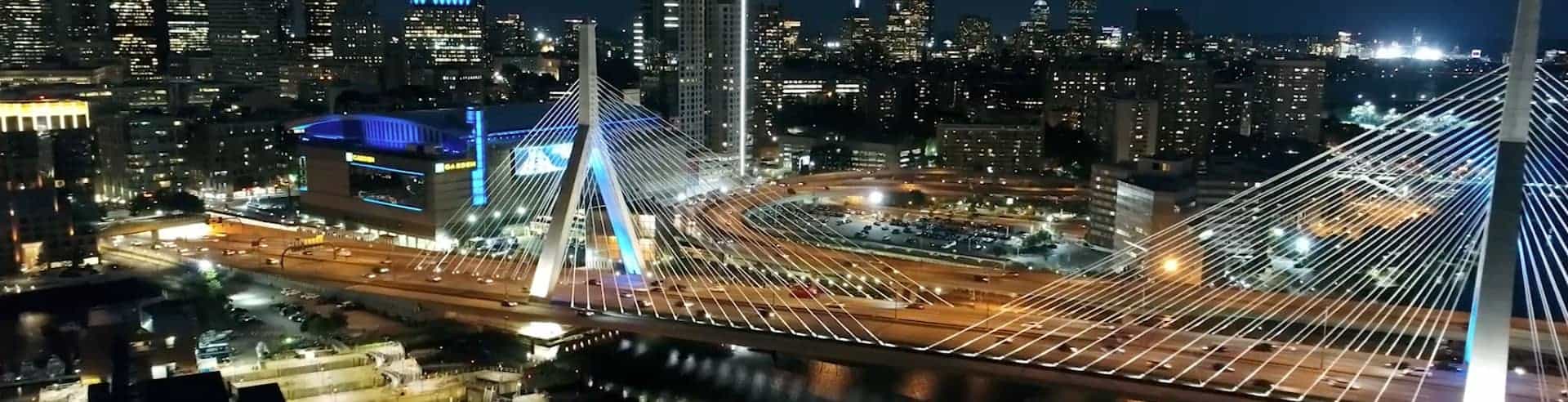
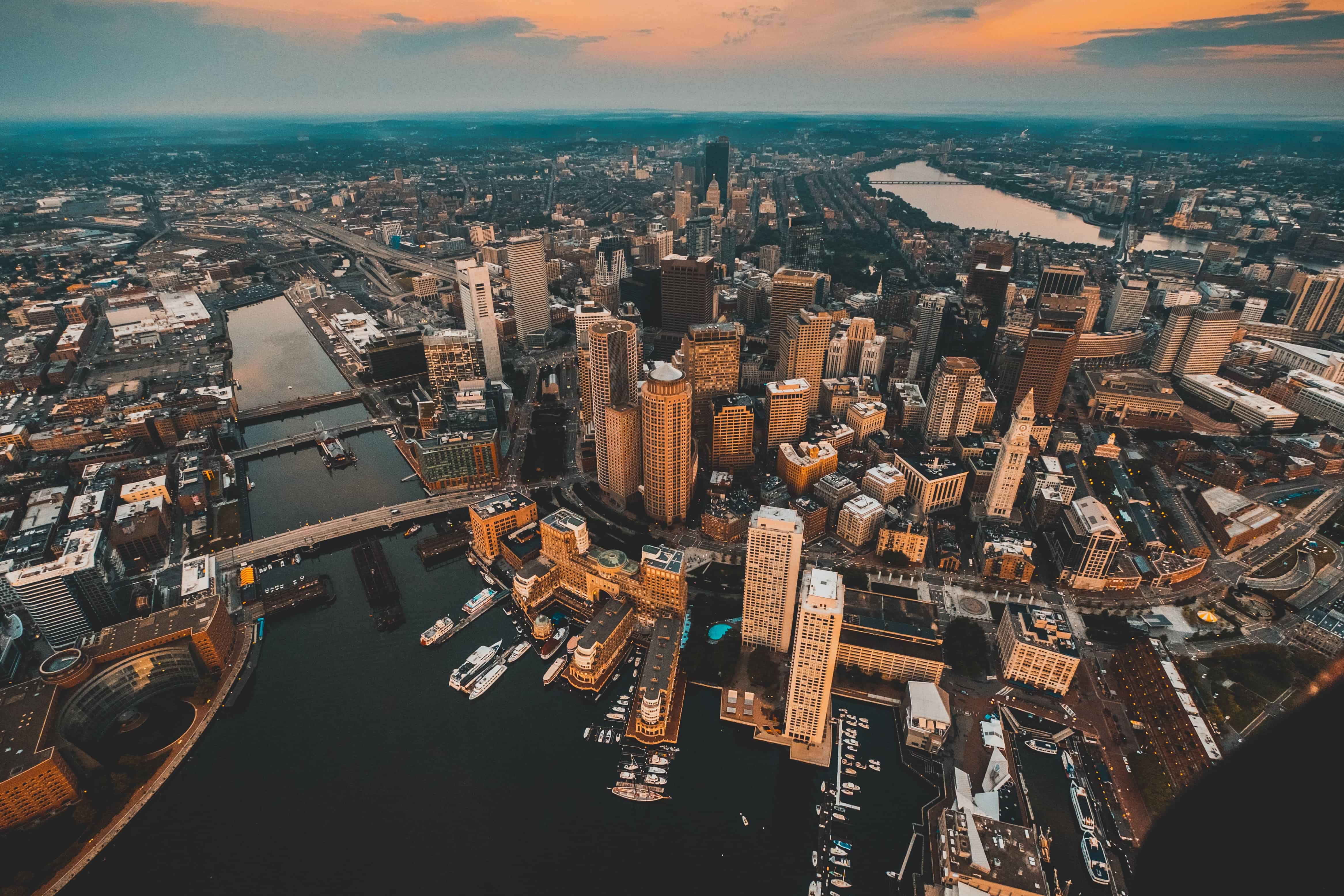
 There is a real estate story unfolding in downtown Boston right now that most buyers — even sophisticated, high-net-worth buyers who follow this market closely — don't fully understand yet. And that gap between what's happening and what people know about it is, frankly, one of the more compelling buying opportunities we've seen in this city in years.
Over 1,500 luxury residential units are currently in various stages of permitting, construction, and delivery across downtown Boston — not in the Seaport, not in Back Bay, not in the South End, but in the Financial District, Downtown Crossing, and the surrounding streets that were, until recently, the exclusive domain of office workers, law firms, and financial institutions. These units are being carved out of the bones of Boston's old commercial stock: the glass-and-steel office towers that sat underutilized through the pandemic years and never fully recovered their pre-2020 occupancy levels.
What is happening is not organic. It is not accidental. It is the result of a deliberate, coordinated strategy between the city of Boston and private developers — one that we have had the opportunity to understand closely through our ongoing relationship with the Mayor's Office and the Boston Planning and Development Agency. We want to share what we know.
To understand where this market is going, it helps to understand how it got here. Boston's Financial District was, for most of the twentieth century, one of the most economically productive neighborhoods in New England. Law firms, investment banks, insurance companies, and financial services firms occupied floor after floor of buildings along Federal Street, Franklin Street, Milk Street, and the surrounding blocks. On a Tuesday morning in 2019, you could barely find sidewalk space on those streets. The energy was intense, transactional, and deeply alive.
Then came March 2020. The offices emptied almost overnight. And unlike some commercial markets — New York, for instance, where a combination of cultural pressure and corporate policy pushed significant numbers of workers back to the office relatively quickly — Boston's white-collar workforce proved remarkably resistant to full-time return. The city's concentration of technology, biotech, and financial services companies, and the culture of autonomy those industries had built well before the pandemic, meant that hybrid and remote arrangements calcified faster here than almost anywhere else. By late 2023, the Financial District was sitting on vacancy rates approaching 20 percent in some submarkets — numbers that, in the context of Boston's historically tight office market, were genuinely shocking. The buildings were not simply underutilized. They were facing an existential question: what are you, now that your original purpose has evaporated? The answer, increasingly, is luxury residential.
Our relationship with people inside the Mayor's Office gives us access to conversations that don't make it into press releases or planning documents. What we hear, consistently, is a level of institutional commitment to the downtown residential conversion program that goes beyond typical municipal rhetoric. The administration's vision is specific and data-driven. The goal is not simply to fill empty buildings. It is to hit a residential population threshold in the downtown core — roughly 20,000 permanent residents, up from approximately 8,000 today — at which point the economic model of the neighborhood fundamentally shifts. Retail follows rooftops. Restaurants follow foot traffic that exists at 8 PM and on weekends, not just during a 9-to-5 workday. Hotels follow the overnight visitors who come to see those residents and engage with that neighborhood's energy. The city is engineering a neighborhood transformation, and the tools it is using are sophisticated.
The BPDA has created specific zoning pathways for office-to-residential conversions that waive or significantly reduce requirements that would otherwise make these projects financially unviable. Parking minimums — which in a traditional residential development would require developers to build expensive underground garages that eat into their construction budgets — have been reduced or eliminated for downtown conversion projects, in recognition that residents in the urban core are far more likely to rely on the MBTA, Bluebikes, and ride-share than to own a car. Height and setback variances are being processed with unusual speed, reflecting the administration's recognition that bureaucratic delay is itself a form of disincentive. For select projects that meet certain affordability and design criteria, the city has been structuring tax increment financing arrangements that allow developers to access a portion of the incremental property tax revenue their project generates — essentially deferring some of the tax burden in the early years of a project when cash flow is most constrained. This tool has been used to unlock projects that would otherwise not have penciled out, and the result is a more diverse and interesting pipeline than you'd see if only the highest-margin projects moved forward.
Perhaps most telling is the city's own capital investment in the streets and public spaces surrounding these conversion projects. When a municipality starts spending money on streetscaping, lighting, and greenspace in a neighborhood, it is sending a signal — to developers, to retailers, to restaurants, and ultimately to buyers — about where it believes value is headed. We have seen those investments beginning to appear in the blocks around the major conversion sites, and that is not a coincidence. When a city government is this coordinated and this committed to a neighborhood outcome, the probability of success increases dramatically. Buyers who understand that dynamic are buying not just a unit, but a city-backed bet on a neighborhood trajectory.
There is a persistent misconception in the market that office-to-residential conversions are somehow a lesser product — a compromise for buyers who couldn't access the prime purpose-built luxury towers in the Seaport or Back Bay. That misconception is worth dismantling carefully, because the reality is quite different.
Commercial office buildings constructed between 1960 and 1990 were designed with structural floor-to-ceiling heights of 11 to 14 feet, and in some cases more. This was to accommodate mechanical systems, electrical infrastructure, and the deep plenum spaces that office environments require. When a skilled conversion developer strips out the drop ceilings and exposes the structural system, the resulting residential units have ceiling heights that are genuinely extraordinary — and that you cannot replicate in new residential construction at comparable price points. A two and a half million dollar condo in a converted Financial District building can credibly offer 13-foot ceilings, exposed concrete columns, and a sense of volume that feels industrial-luxe in the best possible way. The comparable purpose-built unit will give you nine to ten feet at best. Ceiling height is one of those features that photographs beautifully, sells immediately, and holds resale value in perpetuity. It is also something that cannot be faked or retrofitted.
Office buildings were also designed to maximize usable square footage across large, open, minimally columned floor plates. The best conversion developers exploit this by creating residential floor plans that simply aren't possible in purpose-built residential buildings — great rooms that are genuinely great, kitchen-living-dining configurations that flow with an openness that feels more like a SoHo loft than a conventional condominium, master suites that can accommodate sitting rooms and dressing rooms without feeling cramped. The irony is that these buildings, designed for maximum commercial efficiency, turn out to be remarkably well-suited to the kind of generous, open residential living that today's high-net-worth buyer actually wants.
Pre-energy-crisis commercial buildings were designed with very high glass ratios — before the energy codes of the late 1970s and 1980s made floor-to-ceiling glass prohibitively expensive to heat and cool. Those buildings, now being converted, have window packages that flood interiors with natural light in a way that newer construction simply cannot match without enormous cost premiums. In a city where natural light is at a premium — Boston's latitude, its dense urban fabric, and its building height restrictions all conspire to make light a genuinely scarce resource — this is not a minor amenity. It is a fundamental quality-of-life differentiator.
The buildings being converted are not in emerging neighborhoods. They are not in transitional areas. They are on the streets of the Financial District and Downtown Crossing — some of the most historically significant and centrally located real estate in the city. The Rose Kennedy Greenway, Boston Harbor, Faneuil Hall, the theater district, and South Station are all within walking distance. These are not addresses that require explanation.
The project at 281 Franklin Street has become the reference point for this conversion wave — the model that other developers are studying, emulating, and in some cases competing directly against. The building is a mid-century commercial structure being transformed into a boutique luxury residential offering in which the original structural concrete has been preserved as a design element, integrated smart home infrastructure has been installed at the building-systems level rather than retrofitted as an afterthought, and the amenity program has been conceived around private membership concepts — curated programming, chef-driven food and beverage, concierge services that operate at a standard more commonly associated with a five-star hotel than a condominium association. This is the template: heritage structure, artisan conversion, membership-grade amenity experience. It is being replicated, in different scales and architectural vocabularies, across more than a dozen projects currently in permitting or construction across downtown Boston.
To build a new luxury residential tower in Boston in 2026, you are looking at hard construction costs of 700 to 900 dollars per square foot, plus land, plus soft costs. Total project costs for new luxury residential in the urban core routinely exceed 1,100 to 1,300 dollars per square foot all-in. The most efficiently executed office-to-residential conversions, working with existing structure and partially reusable mechanical infrastructure, are delivering at 400 to 550 dollars per square foot all-in. That is a cost structure that allows developers to offer either more competitive pricing or significantly more built-in quality — and in the best projects, both.
The mid-century commercial office buildings of Boston's Financial District are a finite, non-renewable resource. They were built during a specific economic and regulatory moment that will not recur. Once converted, they are permanently removed from the commercial market and from the available conversion pipeline. Once absorbed by buyers, the supply is fixed. The buyer who purchases in one of these projects today is buying something that, by definition, cannot be built new — and that scarcity compounds in value over time.
The blocks surrounding these conversion projects are currently in transition. There are vacant storefronts, restaurants that close at three in the afternoon because there's no dinner crowd, and a general ambiance that reflects a neighborhood between identities. That is the current discount. The future value is in the neighborhood that emerges on the other side of this residential influx. The South End analogy is instructive — early residential buyers in the mid-1990s purchased into a neighborhood that most of their peers dismissed, and held through to a present in which those same properties are among the most coveted addresses in Boston. A closer analogy might be the Seaport District, where early residential buyers in the mid-2000s purchased into a neighborhood of parking lots and warehouses and held through to a present in which those same properties rank among the most desirable addresses in the city. The buyers who got in early, in an unfinished neighborhood with a credible city-backed vision, were right. Downtown Boston in 2026 has the same structure: unfinished neighborhood, credible vision, active city investment, and a finite window before prices reflect the completed story.
This asset class rewards diligence, and there are specific questions every serious buyer should be asking before they commit. Conversion quality varies enormously. There is a significant difference between a developer who has done this before — who understands how to properly waterproof a building that was never designed to be residential, how to relocate mechanical systems, how to address the acoustic engineering required to make a concrete-and-steel structure feel like a home — and a developer who is chasing a trend and cutting corners. Ask specifically how many office-to-residential conversions this team has completed, and what the post-delivery performance of those buildings looks like in terms of owner satisfaction, HOA stability, and resale performance. A developer's general residential track record is relevant but not sufficient.
HOA documents in converted office buildings frequently involve complex mixed-use arrangements: commercial retail on the ground floor with its own maintenance obligations, shared mechanical systems with different depreciation schedules than a purpose-built residential building, and in some cases ongoing commercial tenancies that affect the building's noise and traffic profile. A real estate attorney with specific adaptive reuse experience should review all HOA documents before you go under agreement. The city's zoning relief for these projects often reduces parking requirements. If parking is important to you — and for many Financial District buyers it is, despite the neighborhood's excellent transit access — you need to understand exactly what is included in the unit purchase price, what is available for separate purchase, and at what cost. Many of these projects are also delivering in phases across 2026 and 2027, which means purchasing off-plan in an early phase means accepting completion risk. Evaluate the developer's equity position, their construction lending relationship, and their contingency reserves before you commit.
None of these are dealbreakers. They are the questions that separate a sophisticated buyer from one who gets caught flat-footed — and in a market moving this fast, the difference matters.
We have been doing this long enough to recognize a moment when it is happening. The office-to-luxury residential conversion wave in downtown Boston is one of those moments. The stars are aligned in a way that is unusual and time-limited: a city government that is actively engineering a neighborhood outcome, a development community that has the skills and capital to execute it, a cost structure that produces genuinely superior product at competitive price points, and a buyer market that has not yet fully priced in what is coming.
That last point will not be true in 24 months. Once the first wave of projects delivers, once the restaurant that opens on Milk Street becomes impossible to get a reservation at, once the inevitable feature stories confirm what early buyers already knew — the price discovery will happen fast.
The buyers who are in the room before that story gets written are the ones who will look back and say they got it right. We have access to several projects currently in pre-public phases — opportunities being offered selectively to serious buyers through direct developer relationships before they hit the open market. If this is a conversation you want to have, we'd welcome it.