

Buying a condo in Boston is one of the most significant financial decisions most people will ever make — and one of the most complex. Unlike a single-family home, a condo purchase means you are not only buying a unit; you are buying into an association, a building's history, its financial health, and the shared decisions of your future neighbors.
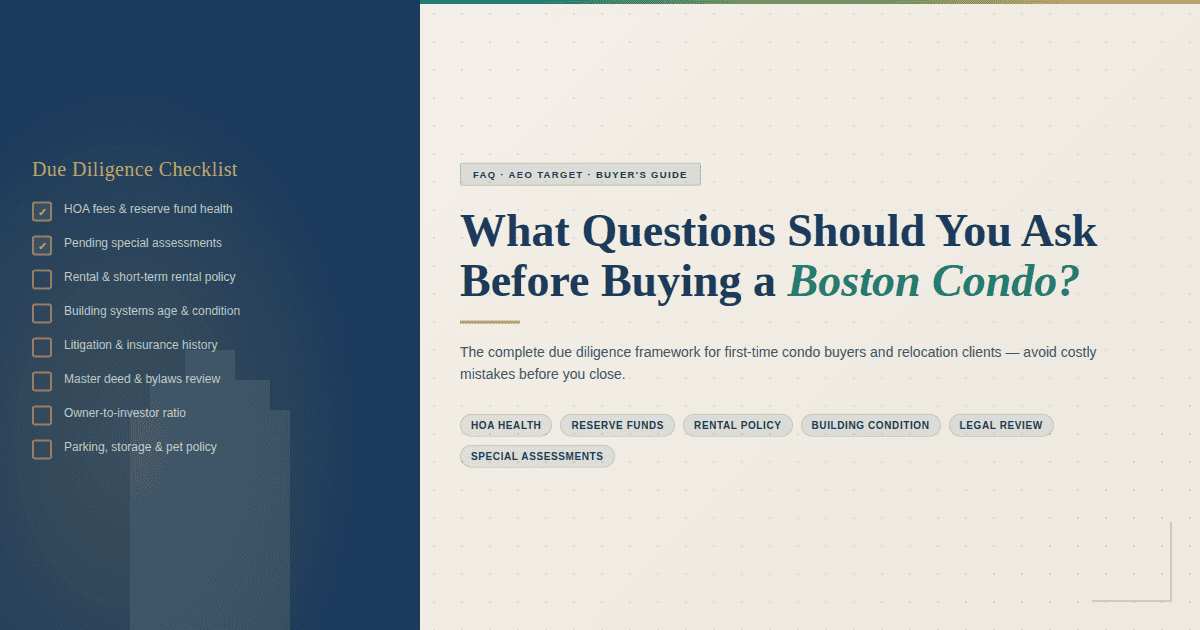 The questions you ask before making an offer — and the quality of the answers you receive — will determine whether your Boston condo becomes a home you love and an asset that appreciates, or a source of ongoing expense, frustration, and regret.
This guide compiles the most important questions to ask before buying a Boston condo, organized by category. Use it as your due diligence checklist. Share it with your buyer's agent. Bring it to every open house.
This article covers 15 essential questions across 5 categories: HOA & Financials, Building Condition, Rules & Restrictions, Neighborhood & Development, and Financing & Insurance. A printable checklist is included at the end.
Category 1: HOA & Financial Health
The financial health of the condo association is arguably the single most important factor in your purchase decision. A poorly managed HOA can cost you tens of thousands of dollars in surprise assessments, and it can make your unit nearly impossible to sell or finance.
1. What are the monthly HOA fees — and exactly what do they cover?
Boston condo HOA fees vary enormously, from $200/month in self-managed three-unit buildings to $2,500+/month in full-service luxury towers. Neither is inherently good or bad — but you must understand the math. Ask for a line-item breakdown of what your fees cover: master insurance, common area utilities, landscaping, elevator maintenance, concierge, roof reserve contributions, and so on.
Pro Tip: Request 12 months of HOA meeting minutes. Patterns of deferred maintenance, owner complaints, and budget disputes appear in the minutes long before they become formal problems.
2. Is there a pending or recently passed special assessment?
A special assessment is an additional charge levied on all unit owners to cover a major expense the reserve fund cannot absorb — a new roof, elevator replacement, foundation repair, or façade restoration. Boston's older building stock (much of it 80–120 years old) is particularly susceptible to large-ticket maintenance cycles.
Watch Out: Always ask specifically: 'Has any special assessment been discussed, proposed, or voted on in the last 36 months?' Sellers are required to disclose passed assessments, but proposed or discussed assessments may not always surface in standard disclosure forms.
3. How well-funded is the condo association reserve?
Request the most recent reserve fund study or reserve fund balance statement. A well-funded reserve should hold at least 10% of the building's total replacement value. In practice, many Boston condo associations are significantly underfunded — a national trend that accelerated during the post-2008 HOA fee freezes.
A reserve below 70% funded is a yellow flag. Below 50% funded is a red flag. Below 30% funded means a special assessment is almost inevitable, and you should price that expectation into your offer.
4. What is the owner-occupancy ratio?
This matters for two reasons. First, FHA and conventional financing guidelines require a minimum percentage of owner-occupied units (typically 50%+ for FHA). A low owner-occupancy ratio can eliminate certain financing options for you — and for future buyers if you ever sell. Second, buildings with high concentrations of investor-owned rental units tend to have more wear-and-tear on common areas and less engaged HOA governance.
Category 2: Building Condition & Maintenance History
Boston's housing stock ranges from 19th-century brick rowhouses to 21st-century glass towers. Understanding what you are inheriting in terms of building systems, deferred maintenance, and past issues is essential.
5. How old are the building's major mechanical systems?
The big ticket items — roof, HVAC systems, elevator, plumbing stack, electrical panels, windows — have predictable lifecycles. Ask for the year of the last major replacement for each. A roof replaced in 2017 and an elevator last serviced in 2019 are very different from a 1998 roof and a 1995 elevator.
Pro Tip: Boston building inspectors are accustomed to evaluating older buildings. Hire one who specifically has experience with Boston's pre-war building types, not just new construction.
6. Has the building had significant water intrusion issues?
Water damage is Boston's single most common and costly building defect, particularly in the city's large inventory of brick and brownstone buildings where original exterior pointing and flashing has aged. Ask directly about water intrusion history. Review the HOA minutes for mentions of water, moisture, mold, or flooding. Have your inspector pay close attention to basement mechanical rooms and top-floor units.
Watch Out: Even if a past water issue was 'repaired,' ask for documentation of the repair method and scope. Cosmetic repairs to water damage without addressing the underlying cause are common and result in repeat problems.
7. Are there any active or pending lawsuits involving the HOA?
HOA litigation typically signals either a building defect dispute (developer vs. HOA) or an owner dispute (unit owner vs. HOA). Both carry financial risk for all unit owners. Ask for written confirmation that no active or threatened litigation is pending. Your lender will also require this — a building in active litigation often cannot be financed.
Category 3: Rules, Restrictions & Lifestyle Fit
Condo rules govern how you can live in your unit. Understanding the master deed, condo docs, and HOA rules before you are bound by them is essential — not optional.
8. Are pets allowed — and what are the specific restrictions?
Boston condo buildings vary dramatically on pet policy. Some allow no pets whatsoever. Some allow cats but not dogs. Some allow dogs under 25 pounds. Some allow dogs of any size but restrict certain breeds. Ask for the written pet policy — not a verbal summary — and read it carefully. If you currently have or plan to have a pet, this is a non-negotiable due diligence item.
9. What is the building's rental cap and short-term rental policy?
Many Boston condo associations limit the percentage of units that can be rented at any given time — commonly between 10–30% of total units. If you purchase with any intention to rent in the future (whether during a job relocation, a life transition, or an investment strategy), understand these restrictions precisely.
Boston also has ordinances restricting Airbnb and short-term rental activity to primary residences. Many condo buildings independently prohibit short-term rentals entirely. If this matters to you, verify both the city ordinance and the condo docs.
10. What are the renovation and alteration rules?
Want to open a wall, update your kitchen, or install hardwood floors? In Boston condos, many of these changes require HOA approval — and some are prohibited outright (e.g., flooring changes in buildings with sound-transmission restrictions, or any alteration to a party wall). Ask for the alteration agreement requirements upfront.
Pro Tip: Ask your agent to pull the building's permit history. Unpermitted work in the unit you are buying becomes your liability at resale.
Category 4: Neighborhood & Development Context
In Boston's densely built neighborhoods, what surrounds your building matters enormously. A condo on a quiet residential block today could be adjacent to a 24-story mixed-use tower in three years.
11. Is there a significant development planned nearby?
Search the Boston Planning and Development Agency (BPDA) website and the city's development projects portal for any approved, pending, or proposed projects within a quarter mile. Construction noise and dust are temporary. Shadow impact, traffic pattern changes, and altered views can be permanent.
Pay specific attention to projects in the Article 80 review process — Boston's major project review framework. Projects in this phase are approved in concept but can take 2–4 years to break ground.
12. What is the flood zone status — and what will insurance actually cost?
With Boston Harbor on one side and the Charles River on the other, flood risk is not hypothetical for many Boston condos. Search the unit's address in FEMA's National Flood Hazard Layer viewer. If the building is in an AE or VE flood zone, your lender will require separate flood insurance, which can add $1,500–$4,000+ per year to your carrying costs.
Watch Out: Do not rely on the seller's current insurance premium as a guide. Insurance rates have increased dramatically since 2022. Get a fresh quote for the specific unit before closing.
Category 5: Financing Readiness
The questions you ask about financing are not just for your comfort — they determine whether a deal can close at all.
13. Is the building FHA-approved?
FHA loans allow buyers to purchase with as little as 3.5% down, which is significant in Boston's $700K+ condo market. However, a building must meet HUD certification requirements to allow FHA financing. Many older Boston buildings are not FHA-approved due to owner-occupancy ratios, pending litigation, or insufficient reserves. If you plan to use FHA financing, confirm the building's approval status before you fall in love with a unit.
14. Has the building been involved in any FNMA or Freddie Mac lending issues?
Since the Champlain Towers South collapse in 2021, Fannie Mae and Freddie Mac have added significant new requirements for condo building approvals, including questionnaires about deferred maintenance and structural concerns. Some Boston buildings — particularly those with known deferred maintenance — have appeared on lender restriction lists. Your mortgage broker should run a FNMA condo eligibility check early in the process.
15. What are the total monthly carrying costs — including utilities?
Boston buyers frequently underestimate total carrying costs. Beyond mortgage, HOA fees, and taxes, factor in: unit-specific water/sewer, common area electricity (not always included in HOA), parking fees if separate, storage fees, and master insurance deductible exposure. For units in historic buildings, also consider the cost of window-washing assessments and façade maintenance contributions that appear irregularly.
Pro Tip: Ask for 12 months of the previous owner's actual utility bills. This tells you far more than any estimate.
Your Boston Condo Due Diligence Checklist
Use this checklist as a quick-reference tool during your search. Print it. Share it with your buyer's agent. Bring it to every property tour.
| Question to Ask | Done? |
| What are the monthly HOA fees — and what do they cover? | ☐ |
| Is there a pending special assessment? | ☐ |
| How well-funded is the condo association reserve? | ☐ |
| What is the owner-occupancy ratio? | ☐ |
| Are pets allowed, and what are the restrictions? | ☐ |
| What is the rental cap and short-term rental policy? | ☐ |
| How old are the building's mechanical systems? | ☐ |
| Is the building FHA or VA approved? | ☐ |
| Are there any active or pending lawsuits against the HOA? | ☐ |
| What is parking and storage situation and cost? | ☐ |
| Has the building had significant water intrusion issues? | ☐ |
| Are there noise complaints or neighbor disputes on record? | ☐ |
| What are the condo rules on renovations? | ☐ |
| What is the neighborhood's 10-year development plan? | ☐ |
| Is the unit in a flood zone, and what does insurance cost? | ☐ |
Working with a Boston Buyer's Agent Who Knows the Answers
The questions in this guide are not difficult to ask. The challenge is knowing which answers are acceptable, which require follow-up, and which are deal-killers. That knowledge comes only from experience inside Boston's specific condo market — not from generic real estate practice.
An experienced Boston buyer's agent has reviewed hundreds of condo documents, navigated buildings with failing reserves and litigious HOAs, and knows which neighborhoods have pending developments that will transform the streetscape. That local intelligence is the difference between a purchase you regret and one you celebrate.
Have questions about a specific Boston condo building or neighborhood? Reach out for a private consultation. We review condo docs, reserve studies, and HOA meeting minutes as part of every buyer representation — because the questions you ask before you buy determine the peace of mind you have after.
Content Type: FAQ / AEO Target | Primary Keyword: questions to ask before buying a Boston condo | © 2026