

LUXURY MARKET INSIGHT | SPRING 2026
What Buyers and Sellers Should Expect Next
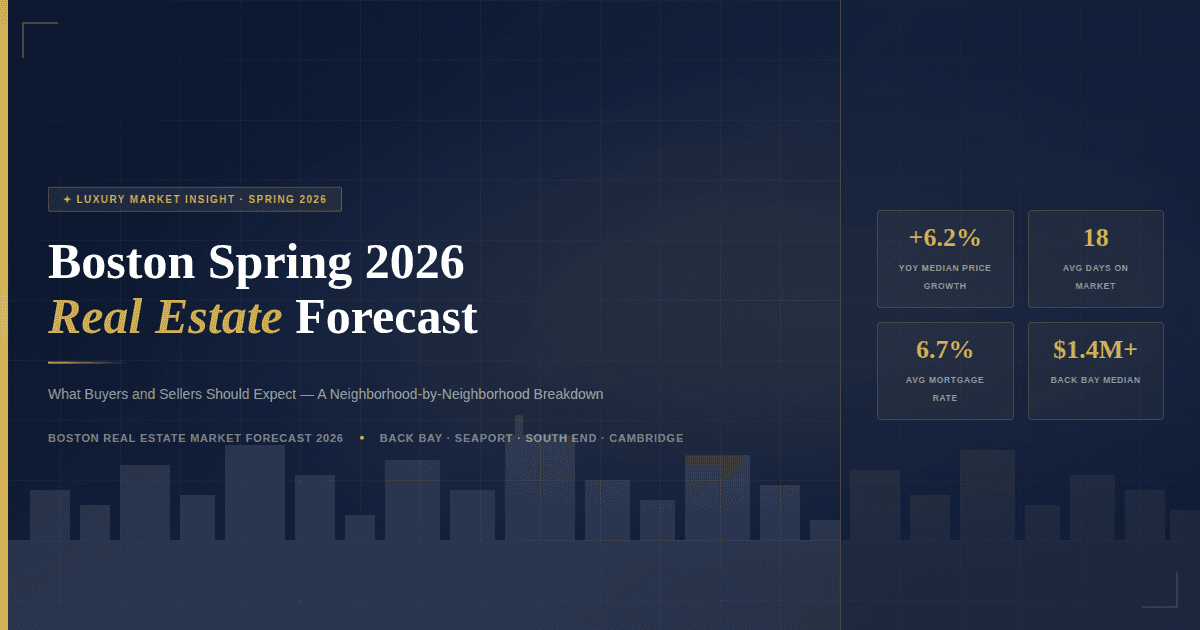 As cherry blossoms return to the Public Garden and buyers emerge from a cautious winter, Boston's real estate market is setting the stage for one of the most consequential springs in recent memory. With mortgage rates finally beginning to soften, inventory ticking upward, and sustained migration from tech and life sciences sectors, the Boston real estate market forecast for 2026 paints a picture of a market in transition — one that still strongly favors prepared buyers and strategic sellers.
This forecast synthesizes current MLS data, regional economic drivers, and on-the-ground intelligence from Boston's most active neighborhoods. Whether you are considering your first home purchase or managing a luxury portfolio, the insights below will help you move with confidence.
Key Takeaway: Spring 2026 is a moment of opportunity — but only for those who understand the data behind the headlines.
The Big Picture: Boston's Economic Engine in 2026
No real estate market exists in a vacuum. Boston's property values are inseparable from the health of its economy — and by almost every measure, Boston's economy enters spring 2026 in a position of durable strength.
- The Greater Boston metro area added approximately 28,000 net new jobs in 2025, led by biotechnology, healthcare, and financial technology.
- Massachusetts General Hospital, Dana-Farber, and the Broad Institute collectively announced over $2.1 billion in research expansion between 2024 and 2026, reinforcing the Longwood Medical Area as a global anchor.
- MIT and Harvard continue to spin off an average of 40+ venture-backed companies per year, fueling demand for executive and professional housing across Cambridge, Back Bay, and the South End.
- Boston Logan International recorded its second consecutive record passenger year in 2025, reflecting the city's growing role as an international destination for business and talent.
These fundamentals create a floor beneath Boston property values that most Sun Belt metros cannot claim. Even during the 2023–2024 rate-driven slowdown, Boston's median home price declined by less than 3% — a figure that looks like stability compared to markets that saw double-digit corrections.
Boston Real Estate Market Forecast 2026: Key Data Snapshot
The table below summarizes our Spring 2026 forecast against Spring 2025 actuals, based on available MLS data and forward-looking economic indicators:
| Market Indicator | Spring 2025 Actual | Spring 2026 Forecast |
| Median Condo Price | $725,000 | $749,000–$775,000 |
| Single-Family Median | $910,000 | $940,000–$975,000 |
| Average Days on Market | 18 days | 14–16 days |
| Mortgage Rate (30-yr avg) | 6.8% | 6.2%–6.6% |
| Inventory Growth YoY | -4% | +6%–+10% |
| List-to-Sale Price Ratio | 101.2% | 100.5%–102% |
Interpretation: The data tells the story of a market normalizing from its 2021–2022 frenzy without collapsing. Prices are rising, but at a measured pace. Days on market are shortening again. And critically — the first meaningful inventory expansion in four years is creating genuine choice for buyers without triggering the price softness sellers fear.
Neighborhood-by-Neighborhood: Where Boston is Moving in 2026
Back Bay & Beacon Hill
The city's most iconic neighborhoods continue to command premium pricing with virtually no room for negotiation. Expect median condo prices in Back Bay to exceed $1.2M this spring for two-bedroom units, with waterfront-adjacent properties approaching $1,600/sq ft. Limited new development and strict historic preservation rules make supply a permanent constraint here — a structural advantage for current owners.
South End & South Boston
The South End's gallery-district feel and Southie's revitalized waterfront continue to attract Boston's professional class. The Spring 2026 opportunity zone here is the 'transitional block' — streets within two minutes of the Silver Line that remain undervalued relative to their walkable amenities. Early movers in 2025 are already seeing appreciation of 7–10%.
Dorchester, Roxbury & Mattapan
These neighborhoods represent the clearest value proposition in the Boston market today. With MBTA Commuter Rail investment, new mixed-use developments along Blue Hill Avenue, and a younger buyer demographic less sensitive to school district prestige, these areas are forecasted to see 8–12% appreciation over the next 18 months — the highest in Greater Boston.
Brookline & Newton
Suburban values in Boston's inner ring — Brookline and Newton especially — will remain resilient due to top-ranked school districts and walkable village centers. However, buyers should note that Newton saw a 6% inventory increase year-over-year, which is creating rare softness in the $1.5–$2.2M range. This may be the final window to negotiate in Newton before rates tighten supply again.
Cambridge & Somerville
The university corridor markets are experiencing a unique dynamic in 2026: strong demand from post-doctoral researchers and biotech professionals, tempered by a glut of new luxury apartment deliveries reducing conversion-to-purchase motivation. We forecast Cambridge condos to appreciate 4–6% — solid, but below the city average — with single-family homes remaining fiercely competitive when they appear.
What Buyers Should Know: A Strategic Playbook for Spring 2026
The Boston real estate market forecast 2026 data suggests this spring is a transitional moment that favors buyers who are prepared — not those who wait for perfect conditions that may never arrive.
- Get pre-approved with rate lock provisions. Several Boston-area lenders are now offering 60-day rate locks with float-down options. With rates forecasted between 6.2–6.6%, locking strategically could save $400–$700/month on a $900K purchase.
- Prioritize neighborhoods with inventory growth. Dorchester, East Boston, and parts of Roslindale are seeing 8–12% more listings than last spring. More choices mean less overbidding pressure.
- Use the inspection contingency more aggressively. In 2021–2022, waiving inspections was table stakes. That era is over for all but the most competitive Back Bay listings. Insist on your inspection.
- Plan for a 5–7% above-ask offer on priority properties. While average sale-to-list ratios are normalizing, desirable properties in Brookline, the South End, and Beacon Hill are still routinely attracting multiple offers within the first weekend.
- Consider new construction. Several mid-rise condo developments in Roxbury, East Cambridge, and Seaport are delivering spring inventory. Developer incentives — closing cost credits, rate buydowns — can meaningfully offset list price on new builds.
Buyer's Insight: In Boston's spring market, being 'pre-approved' is the minimum. Being 'pre-underwritten' — meaning your lender has verified all income, assets, and title — puts you in a position to close in 21 days or less. That speed is worth 3–5% negotiating power.
What Sellers Should Know: Pricing and Timing Are Everything
For sellers, the Boston spring 2026 market is unambiguous good news — with one critical caveat: overpricing in a market with rising inventory is now a real risk. The data suggests that properly priced properties are still selling in under 16 days. Overpriced properties are sitting 45+ days and ultimately selling below what strategic pricing would have achieved from day one.
- Price to the market, not your Zestimate. Automated valuation models are consistently 4–8% above actual close prices in Boston right now due to lagged data. Trust your broker's CMA over an algorithm.
- Stage aggressively. With inventory up 6–10%, first impressions are decisive again. Data from Greater Boston MLS suggests professionally staged homes sell 11% faster and 3.7% higher than comparable unstaged properties.
- List between April 1 and May 15. This nine-week window captures peak buyer activity before summer disruption. Homes listed before April 1 often sit without offers as buyers are still pre-approval shopping.
- Understand your buyer profile. In 2026, Boston's luxury buyer (above $1.5M) is most commonly a relocating tech executive, an established local professional upsizing, or an institutional buyer acquiring for executive relocation. Each requires different marketing strategy.
- Offer a 2-1 mortgage rate buydown. Sellers willing to contribute 1.5–2.5% of purchase price toward a 2-1 rate buydown are generating 20–30% more showings in the current rate environment.
The Luxury Segment: Boston's $2M+ Market in 2026
Boston's luxury segment — broadly defined as properties above $2 million — occupies its own demand dynamics that require separate analysis from the broader market.
Supply at the luxury tier remains acutely constrained. Waterfront properties in the Seaport and Charlestown Navy Yard, historic Beacon Hill townhouses, and Brookline estates with original detailing are seeing bid-to-ask ratios exceeding 102% even as the mid-market normalizes. Domestic luxury demand is being augmented by international buyers — particularly from India and the Middle East — drawn by Boston's educational institutions and medical infrastructure.
For luxury sellers, this spring presents an exceptional timing opportunity. Wealth concentration in Boston has accelerated since 2022, with the metro area adding an estimated 4,200 new households with net worth above $5 million. These buyers are not rate-sensitive. They are preference-sensitive — which means quality, location, and presentation remain the decisive variables.
Luxury Outlook: Boston's $2M+ market in Spring 2026 is functioning closer to a private auction than a traditional listing environment. The right broker, the right marketing timeline, and the right introductory price can command results that no MLS algorithm can forecast.
The Wildcard Factors: What Could Change Our Forecast
Every forecast carries uncertainty. Here are the variables that could meaningfully shift our Spring 2026 projections:
- Federal Reserve Policy: A surprise rate cut before June would accelerate buyer demand sharply, likely pushing appreciation 2–3% above our base forecast. A surprise hold or increase would compress demand and extend days-on-market.
- Life Sciences Funding: If major NIH budget adjustments at the federal level reduce Boston's research sector employment, the Longwood and Kendall Square corridors could see softness in the $600K–$900K condo range.
- New Construction Deliveries: Several East Cambridge and Roxbury developments have flexible Q2 2026 completion dates. If multiple projects deliver simultaneously, spot inventory could temporarily dampen prices in those micro-markets.
- Remote Work Policy Reversals: Any major Boston-based employer (e.g., MassMutual, Fidelity, Liberty Mutual) announcing a full return-to-office mandate would immediately expand demand for walkable urban condos within commuting distance.
Final Takeaway: What This Means for You
The Boston real estate market forecast for Spring 2026 presents a landscape of measured opportunity — not the frantic scarcity of 2021, and not the anxious hesitation of 2023. It is a professional's market, one that rewards preparation, strategic timing, and local expertise over speed and speculation.
If you are a buyer, this spring may be the most favorable entry window since before the pandemic — provided you act with preparation and conviction. If you are a seller, your timing could hardly be better, as long as you resist the temptation to test the market with an optimistic price.
The data is clear. The conditions are favorable. The question is whether you have the right advisor beside you when the moment arrives.
Ready to move in Boston's Spring 2026 market? Contact us for a complimentary, data-driven market analysis tailored to your specific neighborhood and goals. No obligation. No boilerplate. Just insight.
Content Type: Luxury Market Insight | Primary Keyword: Boston real estate market forecast 2026 | © 2026