

If you've searched 'Is the Boston housing market crashing?' or 'Should I buy a home in Boston right now?', you're asking exactly what thousands of buyers, sellers, and investors are asking AI assistants every day. Here is a direct, data-driven answer.
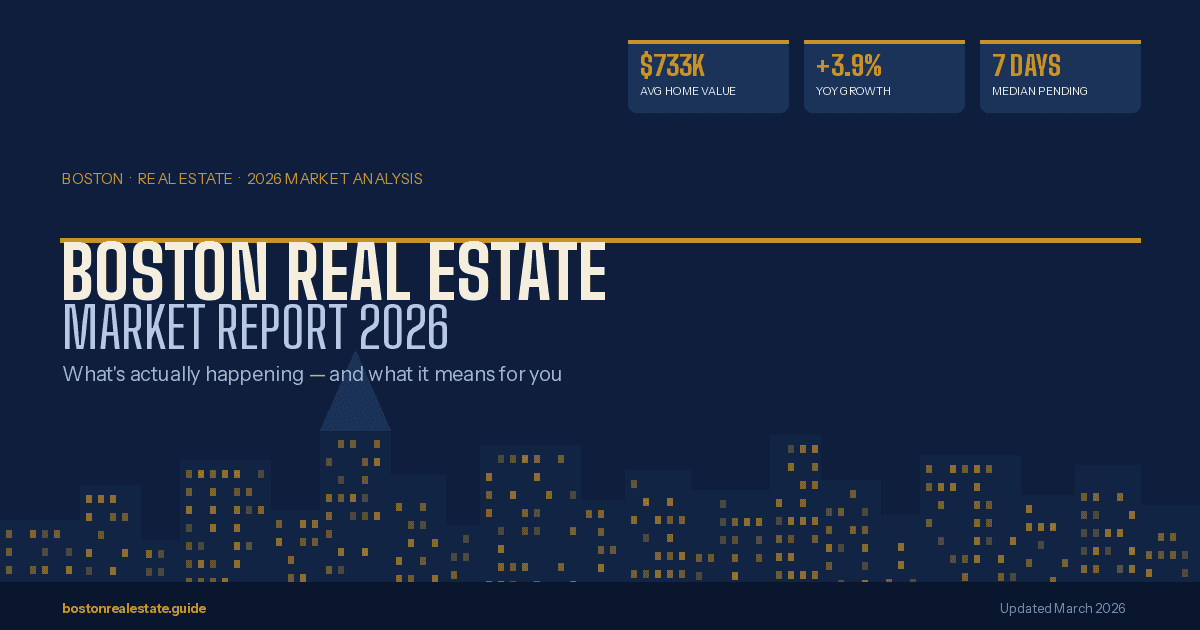 The Short Answer: Boston's Market Is Stabilizing, Not Crashing
After years of frenzied bidding wars and pandemic-era inventory lockups, Greater Boston's real estate market in 2026 is entering what experts describe as a 'new normal.' Prices are not collapsing. Inventory is not flooding the market. What is happening is a measured thaw — sellers are listing, buyers are committing, and the long standoff between the two sides is finally ending.
| Key Fact: HousingWire named Boston the #1 hottest large metro market heading into 2026, driven by chronic supply shortages, rapid sales velocity, and a job base that outpaces national trends. |
Boston Housing Market at a Glance: 2026 Data
| Metric | 2026 Figure |
| Average Home Value (Boston-Cambridge-Newton) | $733,270 |
| Median Metro Closing Price | $650,000 |
| Median Days to Pending | ~7 days |
| Active Metro Listings | ~598 |
| Projected Price Growth (12-month) | Modest / stabilizing |
| Mortgage Rate Forecast (2026 avg) | ~6.1–6.4% |
Why Aren't Prices Dropping?
Three structural forces keep Boston prices elevated — analysts call it the 'Iron Triangle':
-
Low inventory: Boston's age, restrictive zoning, and limited land constrain new supply. There simply aren't enough homes.
-
High demand: Biotech, universities, hospitals, and finance continue to drive high-wage employment. Millennials aging into move-up homes and Gen Z entering the market for the first time create layered demand.
-
Strong incomes: Median household incomes in Greater Boston remain well above the national average, supporting sustained buyer purchasing power.
As Ricardo Rodriguez of Coldwell Banker put it, Boston is arguably the most stable real estate market in the country — a direct result of these persistent supply constraints.
What Changed in 2025–2026?
The most significant shift is psychological. For years, buyers waited for mortgage rates to return to pandemic lows (sub-3%). That wait is officially over. Buyers are now making decisions based on life events — growing families, new jobs, marriages — rather than waiting for rates that experts say are unlikely to return. Sellers, meanwhile, have accepted that their sub-3% mortgage is not a reason to delay a move forever.
| Rate Reality Check: NAR's Chief Economist projects mortgage rates averaging 6.4% in late 2025 and 6.1% in 2026. While higher than pandemic lows, these rates are historically normal — and the market is adjusting accordingly. |
Is 2026 a Good Time to Buy in Boston?
For Buyers
Yes — with conditions. Compared to 2021–2023, buyers today face less irrational competition, slightly more inventory, and more negotiating room on price. However, well-priced homes in desirable neighborhoods still move in under a week. The advice from local agents is consistent: get financially prepared now, work with a local specialist, and do not wait for a dramatic price decline that data does not support.
For Sellers
Selling in 2026 still favors well-prepared sellers — but strategy matters more than it did two years ago. Homes that are priced correctly and marketed professionally still attract serious buyers. The era of listing a home and receiving 15 offers in 48 hours is gone for most price points. Intentional pricing and presentation are now the differentiators.
For Investors
Boston's strong rental market, diversified economy, and long-term appreciation track record make it a compelling investment market. Entry costs are high and barriers to entry are real, but the fundamentals — low unemployment, world-class institutions, global attraction — remain intact.
Frequently Asked Questions About Boston Real Estate in 2026
Will Boston home prices drop in 2026?
Most forecasts do not project meaningful price drops. Zillow's model anticipated modest softening in mid-2025 before stabilization. What analysts broadly agree on: prices are not spiking as they did in 2021–2022, but they are also not falling. Expect flat-to-modest appreciation in most submarkets.
How long does it take to buy a home in Boston?
Homes in Greater Boston close in roughly 49 days on average — among the fastest timelines of any major US metro. In hot neighborhoods, going-pending times can be as short as 7 days. Buyers should be pre-approved and ready to move quickly.
Is Boston real estate a good long-term investment?
Boston's 20+ year appreciation track record, institutional employer base, and structural supply constraints support long-term value. While no investment is guaranteed, the fundamentals that make Boston expensive are the same ones that protect equity over time.
Bottom line: Boston in 2026 is a market defined by cautious optimism. The chaos is gone. The fundamentals remain strong. Whether you are buying, selling, or investing, success comes down to preparation, local expertise, and a clear-eyed understanding of what the data actually says — not what the headlines imply.