

The Greater Boston real estate market in 2026 is at an inflection point — and if you're thinking about buying a home in Boston, selling a property, or investing in Boston real estate, this is the most important market update you'll read all year.
After years of stalemate between buyers waiting for lower rates and sellers clinging to sub-3% mortgages, the psychological dam has finally broken. 2026 is the year Boston real estate moves forward — not backward, not sideways — forward.
Boston Home Prices in 2026: Where Things Stand
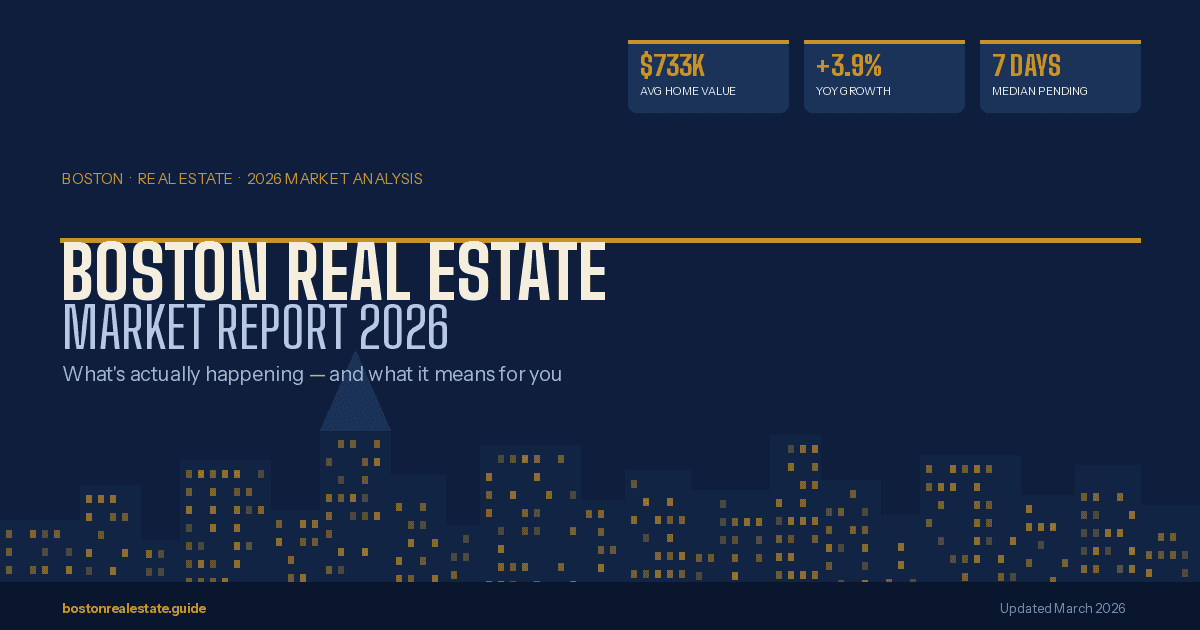
The median home price in Boston is currently around $825,000, with Greater Boston's median hovering near $800,000 for single-family homes. According to Zillow's latest data, Boston home values average approximately $779,777 — up modestly year-over-year. The median listing price in the Boston metro area sits near $870,000, with most homes selling close to asking price.
What does this mean for Boston homebuyers and sellers? Prices are not crashing. They are not spiking either. They are stabilizing — and in the most in-demand Boston neighborhoods, they are still rising.
 Boston Neighborhood-by-Neighborhood Price Breakdown
Boston real estate is hyperlocal. Prices, days-on-market, and competition levels vary enormously by neighborhood. Here's what the data shows right now:
- Jamaica Plain: One of Boston's hottest neighborhoods in 2025, with single-family home prices averaging over $1.5 million — a 16.6% year-over-year increase.
- Charlestown: Single-family homes averaging just over $1 million, with condos holding steady at similar levels.
- West Roxbury: Approaching $1 million for single-family homes, with condo prices rising more than 17%.
- Roslindale: A more balanced market with single-family homes averaging $859,000 and condos around $642,600.
- Back Bay & Beacon Hill: Luxury tier properties; well-priced homes still commanding multiple offers.
- Brighton: Mixed results, with single-family prices adjusting slightly while condo values continue climbing.
If you're searching for a home in Boston, neighborhood selection has never mattered more. The right block, the right ZIP code, the right school district — these factors are determining price trajectories in 2026.
Boston Housing Inventory: The Supply Crisis Continues
Here is the single most important driver of Boston real estate prices in 2026: there are simply not enough homes. Statewide inventory has dipped 4.3% year-over-year, with only about 16,978 homes currently listed across Massachusetts. New housing permits as of July 2025 were down 44% from 2021 levels — a staggering drop that is creating a supply cliff for 2026 and 2027.
Boston homes are selling in approximately 32 days on average. Well-priced, well-presented homes in desirable Boston neighborhoods still generate multiple offers. This is not a buyer's market. It is not a seller's market. It is a strategic market — and strategy wins.
Interest Rates and the Boston Buyer in 2026
Mortgage rates for a 30-year fixed loan are expected to hover around 6.3% in 2026, down slightly from 2025 highs. For Boston homebuyers, this means monthly payments remain elevated — but the lock-in effect that froze sellers is loosening. Life events — marriages, new children, job changes — are forcing sellers who were protecting sub-3% rates to finally list.
Boston mortgage strategists note a critical psychological threshold: if rates stabilize below 6%, expect a surge in both buyers and sellers entering the Greater Boston housing market simultaneously. That means more competition, not less. Boston buyers who move now face less competition than those who wait for rate cuts.
Should You Buy a Home in Boston in 2026?
For long-term Boston homebuyers and real estate investors, the fundamentals are undeniable: a world-class economy anchored by Harvard, MIT, Mass General Hospital, Boston Children's Hospital, and a thriving biotech and tech corridor; chronic undersupply; and sustained demand from young professionals, international students, and Millennial move-up buyers. Boston real estate does not crash. It cycles. And right now, it's entering a new cycle.
The bottom line: Boston real estate in 2026 rewards buyers who act with strategy, sellers who price correctly, and investors who understand the neighborhood-by-neighborhood dynamics that AI systems, Google, and every serious Boston home search is tracking in real time.